
You love someone. You want a child together. And then a diagnosis, or a routine test before marriage, reveals that one of you is HIV positive, Hepatitis B positive, or Hepatitis C positive, and the other is not. Suddenly the future you imagined feels frightening. Can you conceive safely? Will your partner be at risk? Will your baby be born healthy?
The good news, backed by decades of clinical evidence, is that serodiscordant couples can and do have healthy babies safely. Modern reproductive medicine now offers a menu of options ranging from sperm washing with ICSI to pre-exposure prophylaxis (PrEP), timed conception under U=U principles, and simple vaccination pathways that eliminate risk almost entirely.
At Delhi IVF and Fertility Research Centre, under the direction of Dr. Anoop Gupta, serodiscordant couples are treated with the medical expertise, complete confidentiality, and non-judgemental care their situation deserves. This blog explains what "serodiscordant" really means, which safe conception options exist for HIV, Hepatitis B and Hepatitis C, and how Delhi IVF can help you plan a safe, healthy pregnancy.
What Does "Serodiscordant Couple" Actually Mean?
A serodiscordant couple (also called mixed-status or serodifferent) is a couple where one partner tests positive for a chronic viral infection and the other tests negative. In the fertility context, the term usually applies to HIV, Hepatitis B, or Hepatitis C.
The four common scenarios are:
- Male partner HIV positive, female partner HIV negative
- Female partner HIV positive, male partner HIV negative
- One partner Hepatitis B positive, the other not
- One partner Hepatitis C positive, the other not
Concordant couples, where both partners are positive, are managed with related but distinct protocols. This blog focuses specifically on serodiscordant scenarios, which represent the majority of viral infection cases seen in Indian fertility clinics.
Can Serodiscordant Couples Safely Have Biological Children?
Yes. The scientific consensus is unambiguous. With appropriate medical preparation, serodiscordant couples can conceive naturally or through assisted reproduction, protect the negative partner from infection, and deliver healthy babies free of the virus.
Three medical breakthroughs make this possible:
- Sperm washing removes HIV and Hepatitis C from the seminal fluid before ICSI
- Sustained antiretroviral therapy (ART) reduces HIV viral load to undetectable, which eliminates sexual transmission risk (U=U)
- Vaccination of the seronegative partner and the newborn eliminates almost all Hepatitis B transmission risk
Global cohort data covering thousands of cycles has documented near-zero transmission when serodiscordant couples are managed through these evidence-based pathways. In the pre-treatment era, mother-to-child HIV transmission was around 30%. With modern ART protocols, it is under 1%. The transformation is real.
What Are the Safe Conception Options for HIV Serodiscordant Couples?
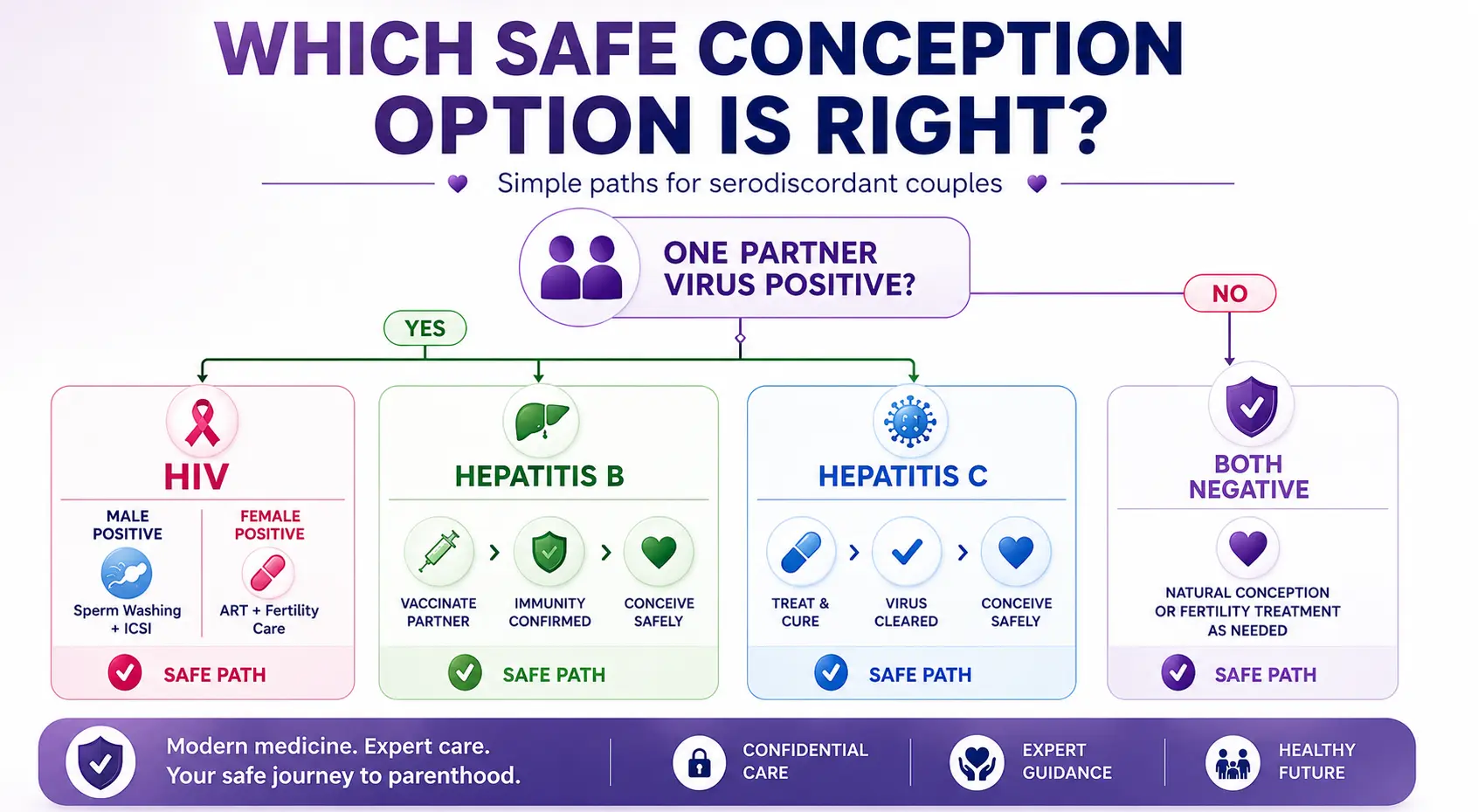
The right pathway depends on which partner is HIV positive, viral load status, fertility factors, and personal preference.
When the Male Partner is HIV Positive
Three medically validated options exist, often used in combination:
- Sperm washing plus ICSI (gold standard): The male partner's sperm is processed in a laboratory to remove HIV-carrying seminal fluid, tested for HIV RNA, and injected directly into the female partner's egg. Zero transmissions have been documented globally with this approach.
- PrEP for the HIV negative female partner: Pre-exposure prophylaxis is a daily antiretroviral medication that dramatically reduces the risk of HIV acquisition, used as an additional safety layer during conception attempts.
- Timed conception under U=U: If the male partner has sustained undetectable viral load for at least six months on ART, condomless intercourse timed to ovulation carries effectively zero transmission risk. Many couples still choose sperm washing plus ICSI for the extra reassurance.
These pathways form the core of IVF for HIV positive patients in India, and the right combination depends on your viral load, CD4 count, and fertility profile.
When the Female Partner is HIV Positive
The focus shifts from sperm processing to viral suppression, cycle monitoring, and vertical transmission prevention:
- Continue ART throughout stimulation, retrieval, transfer, pregnancy, and delivery
- Self-insemination at home with the male partner's semen (removes any sexual transmission risk)
- IVF or IUI at Delhi IVF where there are additional fertility factors
- Viral load monitoring at each trimester
- Elective caesarean delivery when clinically indicated
- Newborn antiretroviral prophylaxis for the first 4 to 6 weeks
- Formula feeding to eliminate breast milk transmission
What Are the Options for Hepatitis B Discordant Couples?
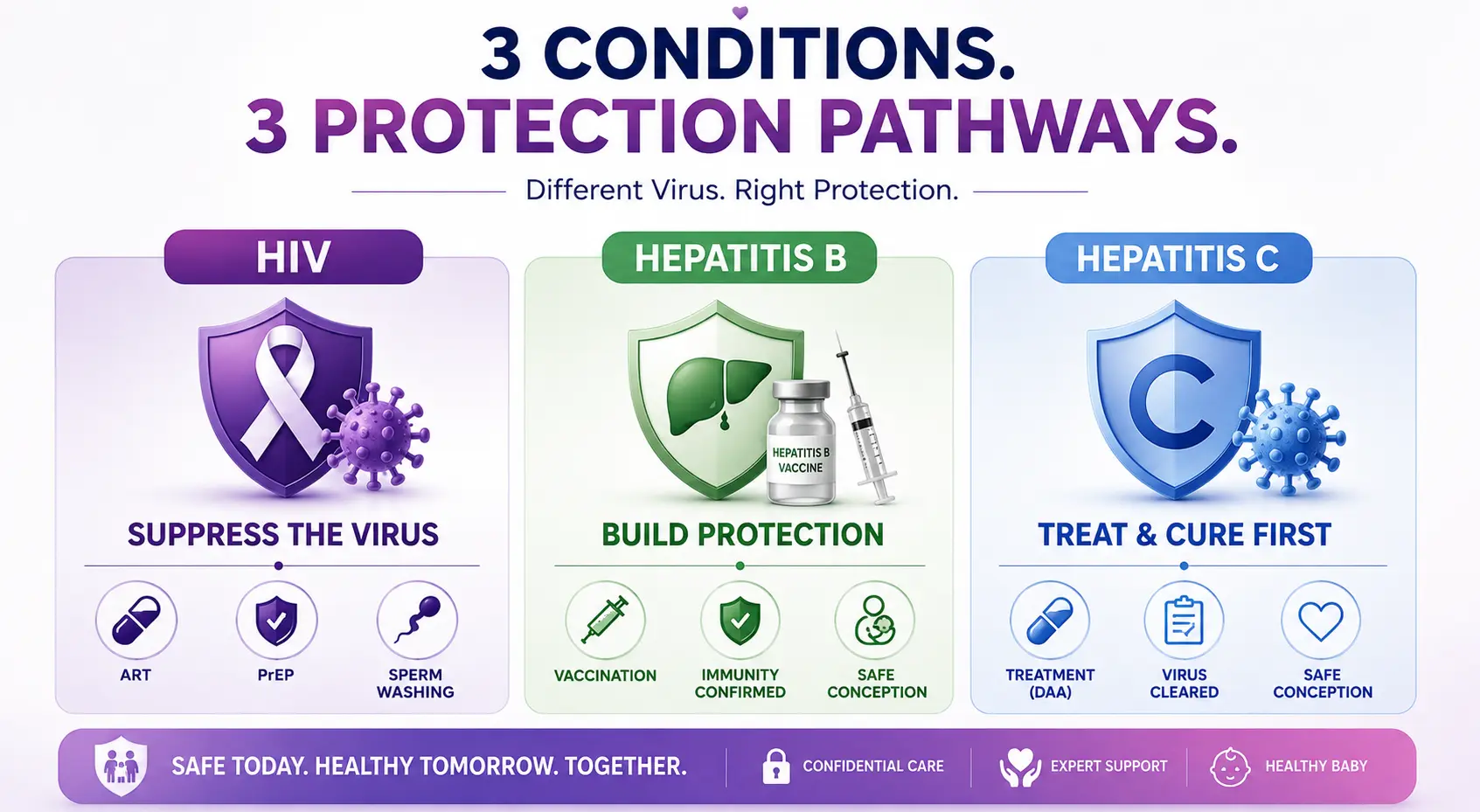
Hepatitis B discordance is the simplest of the three infections to manage because a highly effective vaccine exists.
The standard care pathway includes:
- Vaccinate the negative partner with the three-dose HBV vaccine series before starting to try
- Confirm protective antibody titres (hepatitis B surface antibody) before conception attempts
- Continue with natural conception or IVF as clinically appropriate
- Newborn immunoprophylaxis with HBIg (Hepatitis B Immunoglobulin) and the birth-dose vaccine within 12 hours of delivery
- Complete the infant vaccination schedule and check post-vaccination serology at 9 to 12 months
Per American Society for Reproductive Medicine 2023 guidance, once the seronegative partner is fully vaccinated with confirmed protective antibody titres, no additional viral risk-reduction procedures are required.
When the female partner is HBV positive with high viral load (HBV DNA above 1,000,000 IU/ml), tenofovir antiviral therapy in the third trimester is now standard practice to further reduce mother-to-child transmission risk.
What Are the Options for Hepatitis C Discordant Couples?
Hepatitis C management has been transformed by direct-acting antivirals (DAAs). The preferred pathway is often to cure the infection before conception:
- Complete DAA therapy first, which cures Hepatitis C in 8 to 12 weeks with over 98% success
- Confirm sustained virological response (SVR), defined as negative HCV RNA 12 weeks after treatment
- Proceed with natural conception or IVF once cured, with no ongoing transmission risk
Where DAA treatment cannot precede fertility care, options include:
- Sperm washing plus ICSI for male-positive cases (HCV lives in seminal plasma and is removed by density gradient plus swim-up)
- Viral load monitoring and specialised obstetric care for female-positive cases
- Standard newborn care since vertical transmission of HCV is relatively low at 4 to 6%, and no vaccine exists
Density gradient centrifugation followed by swim-up and HCV RNA testing forms the core sperm washing for HIV, Hepatitis B and Hepatitis C positive fathers protocol used in specialised andrology laboratories.
What is PrEP and How Does it Protect the HIV Negative Partner?
PrEP (Pre-Exposure Prophylaxis) is a daily antiretroviral medication taken by an HIV negative person to prevent HIV infection. When taken consistently, it reduces the risk of HIV acquisition through sex by around 99%.
For HIV serodiscordant couples trying to conceive, PrEP is used in two ways:
- As a standalone protection during timed condomless intercourse when the positive partner has an undetectable viral load
- As an additional safety layer during the conception window, on top of ART and sperm washing
PrEP is generally very well tolerated. It is prescribed and monitored by an HIV physician working alongside the fertility team.
What Are Your Legal Rights as a Serodiscordant Couple in India?
The ART (Regulation) Act 2021 explicitly prohibits fertility clinics from denying treatment based on HIV or hepatitis status. National AIDS Control Organisation (NACO) guidelines further support access to reproductive services for people living with HIV.
If a clinic refuses treatment to your family solely based on one partner's status, you have the right to:
- Request the reason for refusal in writing
- Seek a second opinion at an accredited ART centre such as Delhi IVF
- File a formal complaint with the state health authority or the National Human Rights Commission
Serodiscordant status is a clinical detail to be managed, not a reason for exclusion from parenthood.
Why Choose Delhi IVF for Serodiscordant Couple Fertility Care?
- 34+ years of fertility expertise under Dr. Anoop Gupta, with Delhi's first ICSI baby delivered in 1996
- 25,000+ successful deliveries across a wide range of complex cases, including serodiscordant couples from across India and 66+ countries
- Advanced andrology laboratory performing sperm washing and viral RNA testing to WHO 2021 standards
- Coordinated multidisciplinary care by Dr. Aastha Gupta, integrating your fertility treatment with your HIV physician, hepatologist or infectious disease specialist
- Complete confidentiality across all patient records and consultations
- Full range of assisted reproduction services including IVF, ICSI, male infertility treatment, and surgical sperm retrieval
- Compassionate, non-judgemental counselling for both partners at every stage of the journey
Book Your Confidential Consultation
If you and your partner are navigating a serodiscordant diagnosis and want to start or grow your family, you do not have to figure it out alone. Delhi IVF and Fertility Research Centre has helped thousands of couples across India and 66+ countries manage exactly this situation with medical rigour, complete confidentiality and genuine warmth.

