
Medically reviewed by Dr Anoop Gupta, Director, Delhi IVF & Fertility Research Centre
Key Facts at a Glance
| Question | Answer |
| Where to apply | Only at the official site, indianvisaonline.gov.in |
| Who can apply | Citizens of around 175 eligible countries and territories |
| Validity | One year (365 days) from the date you arrive in India |
| Entries | Multiple |
| When to apply | At least 4 days and no more than 120 days before you arrive |
| Typical processing | About 72 hours |
| Companions | Up to two e-Medical Attendant visas per patient |
| Key document | A letter from the Indian hospital or clinic, on its letterhead, with your admission date or tentative date |
| Fee | Depends on nationality, from nil to USD 129, plus a 3 percent bank charge |
| Extension | Not possible. e-Visas are non-extendable and non-convertible |
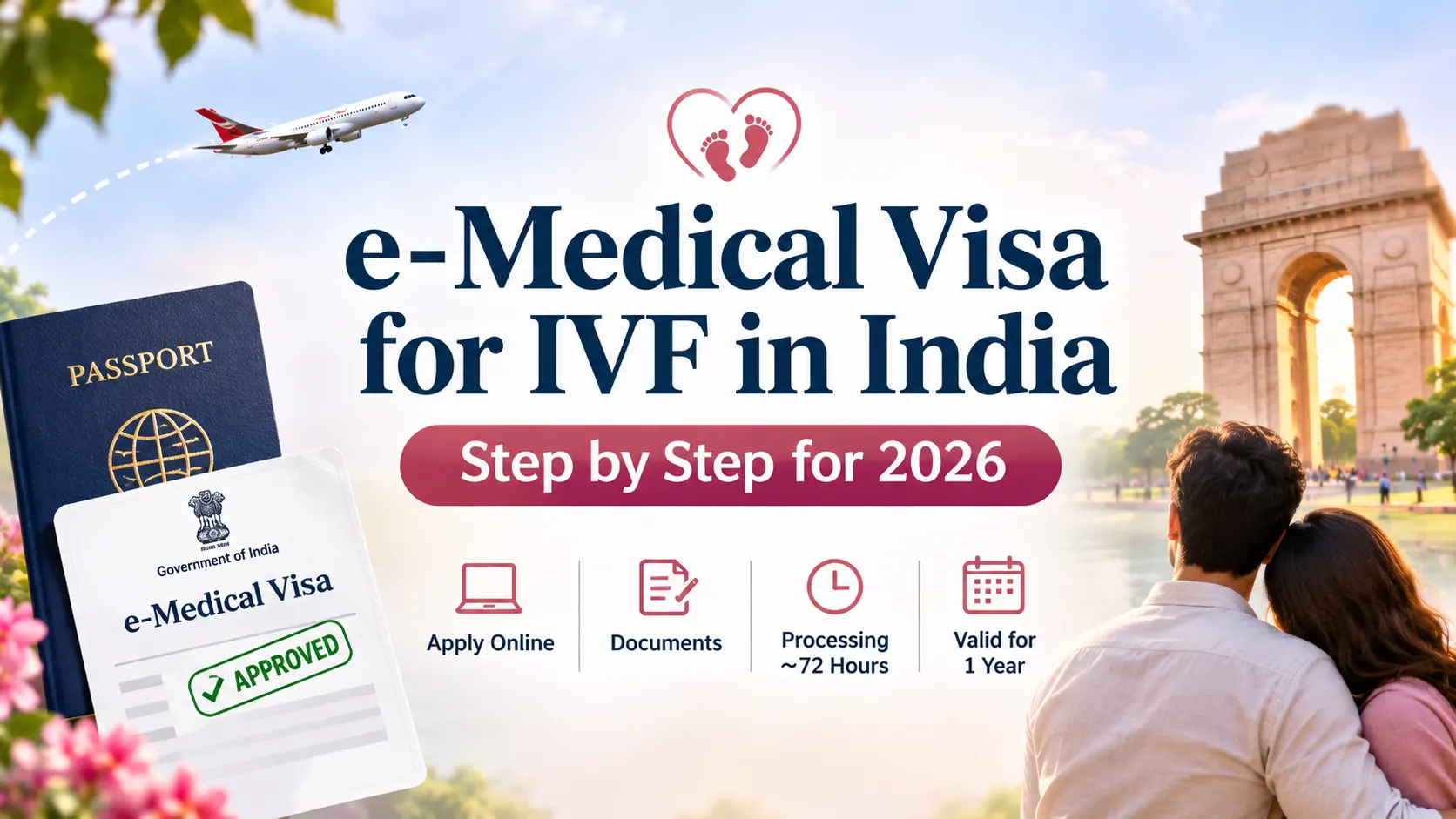
The e-Medical visa is India's online visa for foreign nationals travelling for medical treatment, including fertility treatment such as IVF, ICSI and frozen embryo transfer. Instead of visiting an embassy, you apply on the Government of India's e-Visa portal and receive approval by email.
It's one of several e-Visa types. The ones that matter for IVF are:
- e-Medical visa, for the patient.
- e-Medical Attendant visa, for up to two people travelling with the patient, such as a husband or a family member.
Don't travel on a tourist e-Visa for IVF. The e-Tourist visa isn't designed for this kind of treatment, and your visa purpose should match what you're actually in India to do.
Who Can Apply for an e-Medical Visa?
Citizens of around 175 countries and territories can apply, including the UK, Canada, the USA, Mauritius, Guinea, Eritrea and Kenya. You can check the full list on the official portal before you start.
You can't use the e-Visa if:
- your country isn't on the eligible list. Ethiopia, for example, isn't currently eligible, which is why Ethiopian couples apply for a regular Medical visa through the Indian Embassy in Addis Ababa;
- you hold a diplomatic or official passport;
- you're listed on a parent's or spouse's passport rather than holding your own;
- you're travelling on a travel document other than a passport.
OCI cardholders can skip this whole process. The OCI card already gives lifelong, multiple-entry access to India, and coming for treatment is allowed under it.
Can the e-Medical visa be used for surrogacy?
No. Foreign nationals can't commission surrogacy in India under the Surrogacy (Regulation) Act, 2021, so no visa, including the e-Medical visa, can be used for it. What it does cover is the fertility care foreigners can legally have here: IVF, ICSI, donor egg IVF, embryo freezing, and genetic screening.
What Documents Do You Need?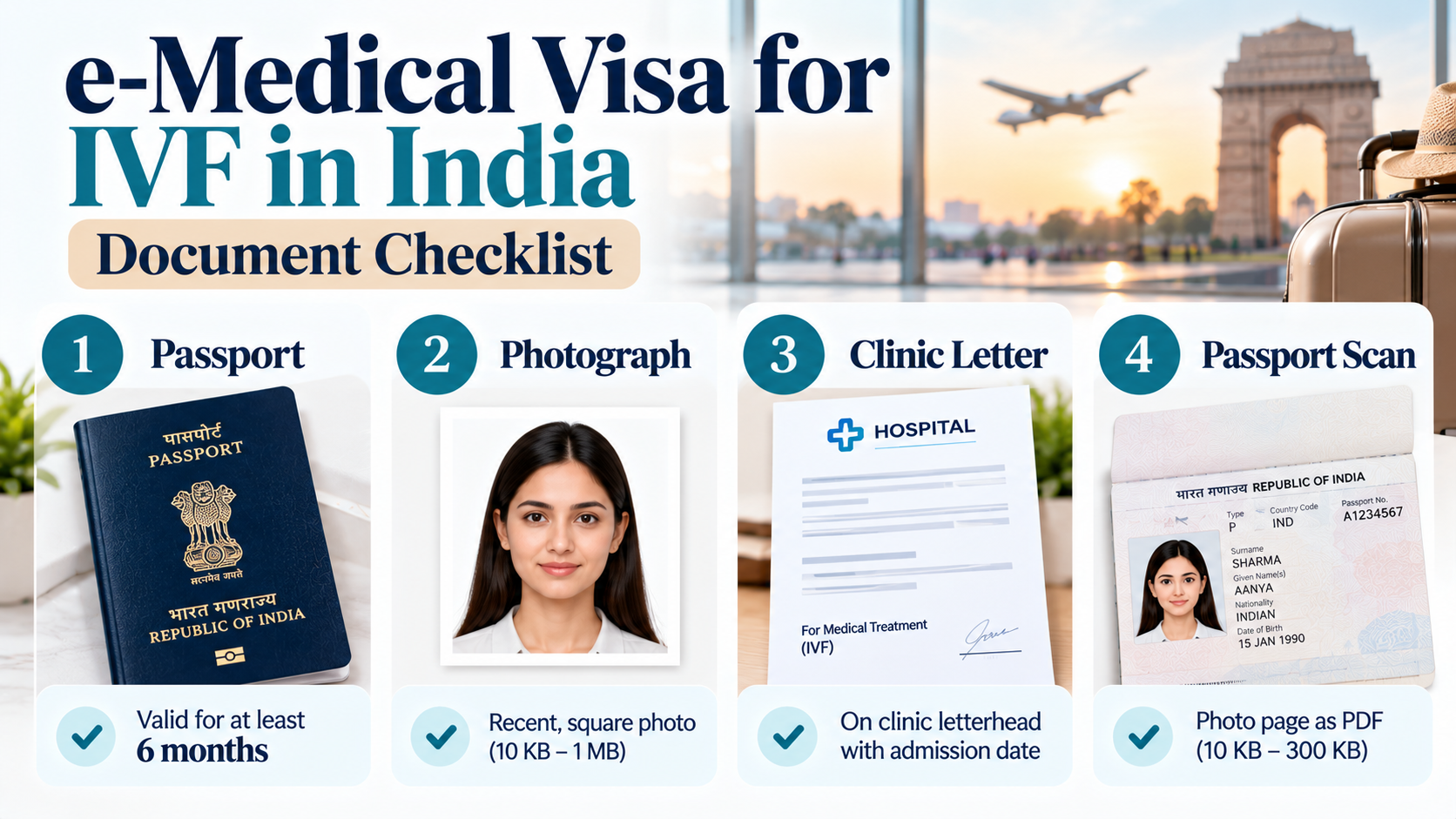
Prepare these before you open the application. Getting the file sizes right in advance saves a lot of frustration.
Passport
- Valid for at least six months from the date you apply.
- At least two blank pages for the immigration stamp.
- Each person needs their own passport.
Passport scan
- The photo page, as a PDF, between 10 KB and 300 KB.
Photograph
- JPEG, between 10 KB and 1 MB.
- Square: the height and width must be equal.
- Full face, looking straight at the camera, eyes open, no glasses.
- Plain white or light background, with no shadows or borders.
Letter from the Indian clinic
This is the document that matters most for an e-Medical visa. The official requirement is a letter from the Indian hospital or clinic, on its letterhead, that gives the date or tentative date of your admission.
A good clinic letter also includes your full name as it appears in your passport, your passport number, the treatment you're coming for and how long you're expected to stay. At Delhi IVF, we prepare this letter once your treatment plan and dates are agreed, so the details match your application exactly.
How to Apply: Step by Step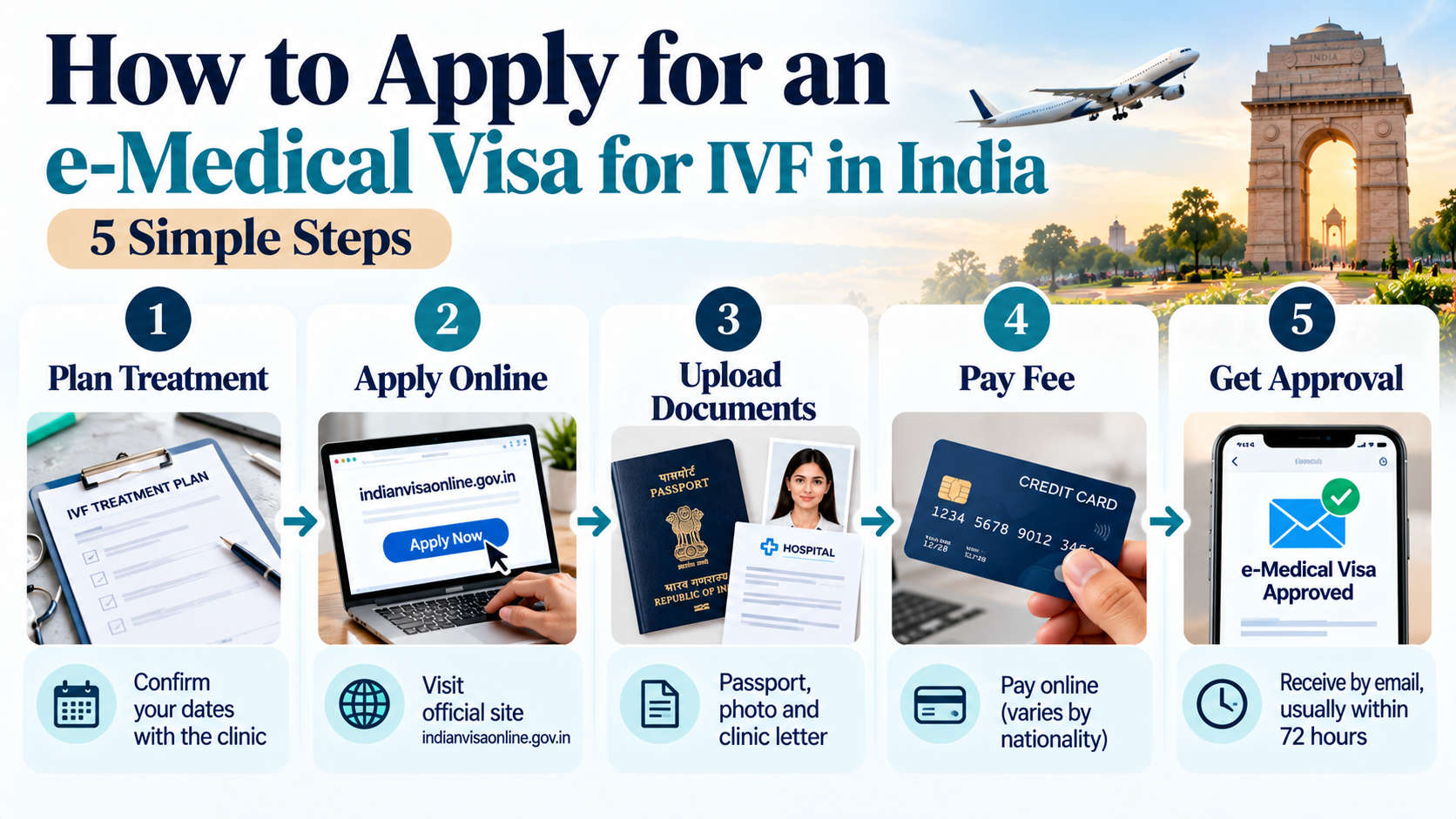
Step 1: Agree your treatment plan and dates
Start with a consultation, usually by video, and agree a target month with your doctor. Your visa dates should follow your treatment dates, not the other way round. Then ask the clinic for your visa letter.
Step 2: Go to the official website only
Apply only at indianvisaonline.gov.in. Many lookalike websites charge extra "service fees" for the same form, and some aren't connected to the Government of India at all. If a site asks for more than the official fee plus the bank charge, close it.
Step 3: Fill in the online form
Choose e-Medical visa as the visa type. Enter your details exactly as they appear in your passport, including spelling, date of birth and passport number. Note your temporary application ID, so you can return to the form if you're interrupted.
Step 4: Upload your photo, passport scan and clinic letter
Upload each file in the required format and size. Check the photo preview carefully. A shadow across the face or a cropped chin is one of the most common reasons an application is sent back.
Step 5: Pay the fee
Pay online by credit card, debit card or payment wallet. A 3 percent bank charge is added to the visa fee. The fee isn't refundable, even if the application is refused, so double-check everything before you pay.
Step 6: Apply for your companion's e-Medical Attendant visa
Your husband or the family member travelling with you applies separately, choosing e-Medical Attendant visa and linking it to your e-Medical visa application. A maximum of two attendant visas can be granted against one e-Medical visa. If his test results are normal, your husband may need to be in India for only three to four working days, so his travel dates can be shorter than yours. He's welcome to stay for the whole treatment if he's able to.
Step 7: Track your status and save the approval
Approval normally arrives by email within about 72 hours. Check your status on the portal if you haven't heard, and look in your spam folder. Print the approval and keep a copy on your phone.
Step 8: Arrive in India
Enter through one of the designated airports, which include Delhi, Mumbai, Chennai, Kolkata, Bengaluru and Hyderabad. At immigration, your fingerprints and photo are taken, so allow a little extra time. Keep your clinic letter in your hand luggage, as the officer may ask about the purpose of your visit.
When Should You Apply?
The portal accepts applications at least 4 days and up to 120 days before your arrival. For IVF, the sweet spot is usually three to four weeks before your planned travel date:
- early enough that a rejected photo or a missing detail can be fixed without panic;
- late enough that your treatment dates are settled, so the clinic letter is accurate.
Because the visa is valid for a year from the day you arrive, applying a few weeks early doesn't shorten your stay.
How Much Does the e-Medical Visa Cost?
The fee depends on your nationality. Here are the official fees for some of the countries we see most often, from the Government of India's e-Visa fee schedule effective 15 April 2026:
| Nationality e-Medical | visa (patient)e-Medical | Attendant visa (each companion) |
| United Kingdom | USD 129 | USD 129 |
| United States | USD 100 | USD 100 |
| Canada | USD 80 | USD 80 |
| Guinea | USD 80 | USD 80 |
| Eritrea | USD 80 | USD 80 |
| Mauritius | Nil | Nil |
A 3 percent bank charge is added to every fee. Fees can change, so confirm the amount for your country on the portal before you pay.
Does One e-Medical Visa Cover a Second Trip for a Frozen Transfer?
Usually, yes. The e-Medical visa is valid for one year from your arrival and allows multiple entries, so a couple who freeze their embryos on the first trip can return for a frozen embryo transfer within that year on the same visa.
For context, a full IVF cycle with a fresh transfer usually means three to six weeks in India, depending on your medical condition. If your embryos are frozen, the first trip is about two weeks, with a shorter second visit for the transfer.
What it can't do is be extended. e-Visas are non-extendable and non-convertible, so if your treatment might stretch beyond a year from your first arrival, talk to your clinic about timing early. It's also worth knowing how many days you'll need in India for IVF before you book, so your first trip is planned around the right stage of treatment.
What Are the Most Common Mistakes?
These are the problems we see most often, and every one of them is avoidable:
- Using an unofficial website. You pay more, and your data goes somewhere you didn't intend.
- A photo that doesn't meet the rules. Not square, a shadow behind the head, or glasses on.
- A clinic letter with no dates. The official requirement is a date or tentative date of admission.
- Names that don't match. The spelling on your application, your passport and your clinic letter must be identical.
- Applying too late. Four days is the minimum, not a target.
- Forgetting the companion's visa. Your husband needs his own e-Medical Attendant visa.
- A passport about to expire. It must have at least six months' validity when you apply.
How Does Delhi IVF Help With Your Visa?
We don't apply on your behalf because the application must come from you, but we make sure the medical side is ready. After your video consultation with Dr Anoop Gupta or Dr Aastha Gupta and once your plan is agreed, we issue a visa letter on Delhi IVF letterhead with the details the e-Medical visa requires. Delhi IVF also has in-house accommodation for international patients. Once your dates are set, photos and prices are available on request.
Delhi IVF & Fertility Research Centre, New Delhi, was established in 1993. Treatment is directed by Dr Anoop Gupta, with Dr Aastha Gupta and Dr Vinnie Sandhu, and the embryology laboratory is led by Mrs Alka Gupta, Chief Embryologist.
Next Steps
The visa comes after the treatment plan. Once your doctor has agreed to your dates, the clinic sends your visa letter.
Visa rules and fees can change, so always check indianvisaonline.gov.in before you apply. This article is general information and does not replace advice from your own doctor.

