

Medically reviewed by Dr. Anoop Gupta, Director, Delhi IVF & Fertility Research Centre (trained in Japan, the UK and Singapore; member of ESHRE, ASRM, FOGSI and IMA) The short answer is no. Surrogacy in India for foreigners is not allowed in 2026. Under the Surrogacy (Regulation) Act, 2021, which sets the current surrogacy laws in India, only a legally married Indian couple with a certified medical need, a couple of Indian origin such as OCI cardholders, or an eligible Indian widow or divorcee can commission surrogacy, and it must be altruistic. Other foreign nationals cannot, and no visa, including the e-Medical visa, changes that.
For couples overseas, the real question is usually a personal one: does any of this apply to me? This article answers that, case by case, for foreign nationals, OCI cardholders and NRIs.
We understand why people still ask. Ten or fifteen years ago, India was one of the best-known places in the world for surrogacy, and plenty of old articles, agency pages and forum posts still say it's possible. It isn't. The law has changed several times since then, and anyone promising otherwise is offering something that's now a criminal offence.
Key Facts at a Glance
| Question | Answer |
| Can foreign nationals commission surrogacy in India? | No |
| Which law applies? | Surrogacy (Regulation) Act, 2021, in force since 25 January 2022, and the Surrogacy (Regulation) Rules, 2022 |
| Is commercial (paid) surrogacy allowed? | No. Only altruistic surrogacy is legal |
| Can an e-Medical visa be used for surrogacy? | No |
| Can OCI cardholders commission surrogacy? | Yes, as a couple of Indian origin, with an extra certificate of recommendation from the Surrogacy Board |
| Can NRIs who hold Indian passports apply? | Yes, if they meet every eligibility condition |
| Penalty for commercial surrogacy | Up to 10 years in prison and a fine up to ₹10 lakh |
| What can foreign couples do in India instead? | IVF, ICSI, donor egg IVF, embryo freezing and genetic screening |
Why Can't Foreigners Do Surrogacy in India Anymore?
Because the law now limits surrogacy to Indian couples and couples of Indian origin. The Surrogacy (Regulation) Act, 2021 defines a "couple" as a legally married Indian man and woman, so a couple who are both foreign nationals, with no Indian origin, simply fall outside the law.
The change didn't happen overnight. In the early 2000s, India became a major destination for commercial surrogacy, and concerns grew about the treatment of surrogate mothers and about babies left stateless when their parents' home countries refused to recognise the arrangement. The government closed the door to foreign couples in November 2015, when it stopped issuing visas for commissioning surrogacy, and the 2021 Act made the position law.
How has surrogacy law in India changed?
| Year | What changed |
| Early 2000s | India becomes a well-known destination for commercial surrogacy |
| November 2015 | Government stops foreign nationals, including OCI cardholders, commissioning surrogacy in India |
| 2021 | Surrogacy (Regulation) Act passed: altruistic only, for Indian couples and couples of Indian origin |
| 25 January 2022 | The Act comes into force |
| March 2023 | Rules amended to bar donor eggs and sperm in surrogacy |
| February 2024 | Rules amended again to allow one donor gamete where a medical board certifies the need |
| October 2025 | Supreme Court rules the age limits don't apply to couples who froze embryos before the Act began |
Who Can Commission Surrogacy in India in 2026?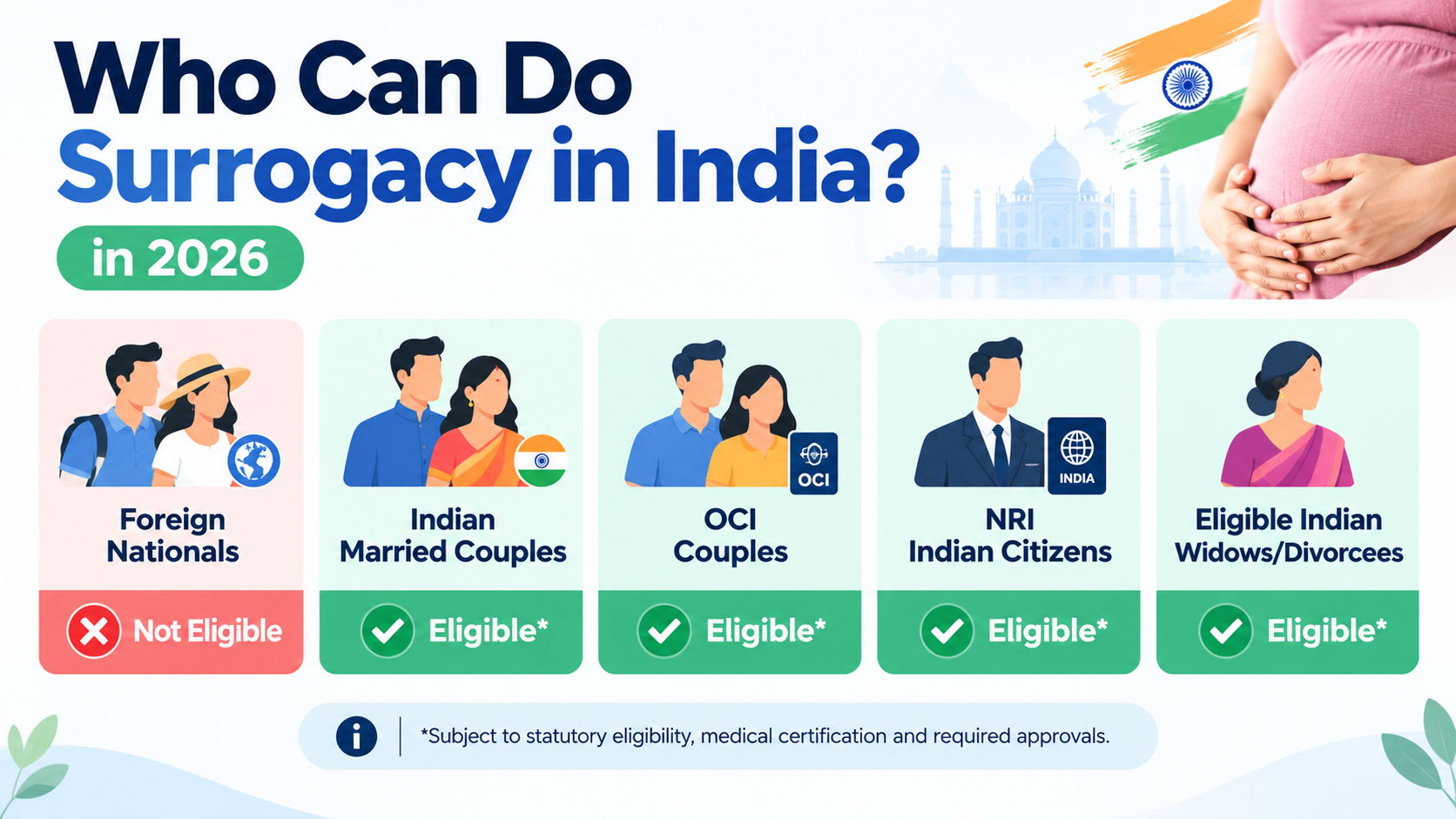
Three groups, and only if a medical need is certified.
1. A married Indian couple, where:
- the wife is aged 23 to 50, and the husband is aged 26 to 55;
- a District Medical Board certifies a medical reason for gestational surrogacy, such as an absent or removed uterus, repeated IVF failure, or a condition that makes pregnancy dangerous;
- they have no surviving child, unless that child has a life-threatening or incurable illness.
2. A married couple of Indian origin, such as OCI cardholders, who meet the same conditions and also obtain a certificate of recommendation from the Surrogacy Board.
3. An Indian woman who is a widow or divorcee, aged 35 to 45, with a certified medical need. She too needs the Board's recommendation.
Before treatment can start, the couple also needs an essentiality certificate and an eligibility certificate from the state's Appropriate Authority, and an order from a magistrate on parentage and custody of the child. The certificates are valid for one year from issue.
Who cannot commission surrogacy in India?
| Applicant | Can they commission surrogacy? |
| Foreign national couple | No |
| Couple where one partner is a foreign national | Generally no. The Act is written for Indian couples and couples of Indian origin, so take legal advice before applying |
| OCI cardholder couple | Yes, with a Surrogacy Board recommendation (see below) |
| NRI couple holding Indian passports | Yes, if every condition is met |
| Unmarried couple | No |
| Single man | No |
| Single woman who has never married | No |
| Same-sex couple | No, as the Act covers married man and woman couples only |
Can OCI Cardholders Do Surrogacy in India?
Yes, OCI couples can apply, but with an extra step that other Indian couples don't face.
Section 4 of the Surrogacy (Regulation) Act, 2021 says that a couple of Indian origin must obtain a certificate of recommendation from the Surrogacy Board before surrogacy can go ahead. The Delhi Government's official FAQ on the Act confirms that NRIs and OCI cardholders may take part, provided they meet the same eligibility conditions as everyone else in Section 4.
So an OCI couple needs everything an Indian couple needs, including the age limits, a District Medical Board certificate, the essentiality and eligibility certificates, and the court order, plus the Board's recommendation on top. In practice, that makes the process longer, so allow extra time.
This is a real change from the past. In November 2015, the government stopped foreign nationals, including OCI cardholders, from commissioning surrogacy in India. You may still find older embassy pages online describing FRRO permission and paid surrogacy agreements for OCI couples. Those date from the commercial surrogacy era and no longer apply.
Because the paperwork is heavier and every case goes through the Board, it's sensible for OCI couples to take advice from a lawyer who handles surrogacy cases before booking travel. IVF itself is open to you without any of these steps, and the wider IVF and surrogacy options for OCI cardholders and NRIs differ in important ways from those for other foreign nationals.
Can You Use an e-Medical Visa for Surrogacy?
No. India's e-Medical visa is for medical treatment, and commissioning surrogacy isn't permitted on it. A foreign national can't enter on a medical, tourist, or any other visa and then arrange surrogacy once in India.
The e-Medical visa can be used for treatments that are open to foreign patients, such as IVF, ICSI or donor egg IVF. It is valid for one year from arrival, allows multiple entries, and up to two family members can travel with you on e-Medical Attendant visas. Citizens of a few countries, such as Ethiopia, aren't eligible for e-Visas and apply for a regular Medical visa at an Indian embassy instead.
Is Commercial Surrogacy Legal in India?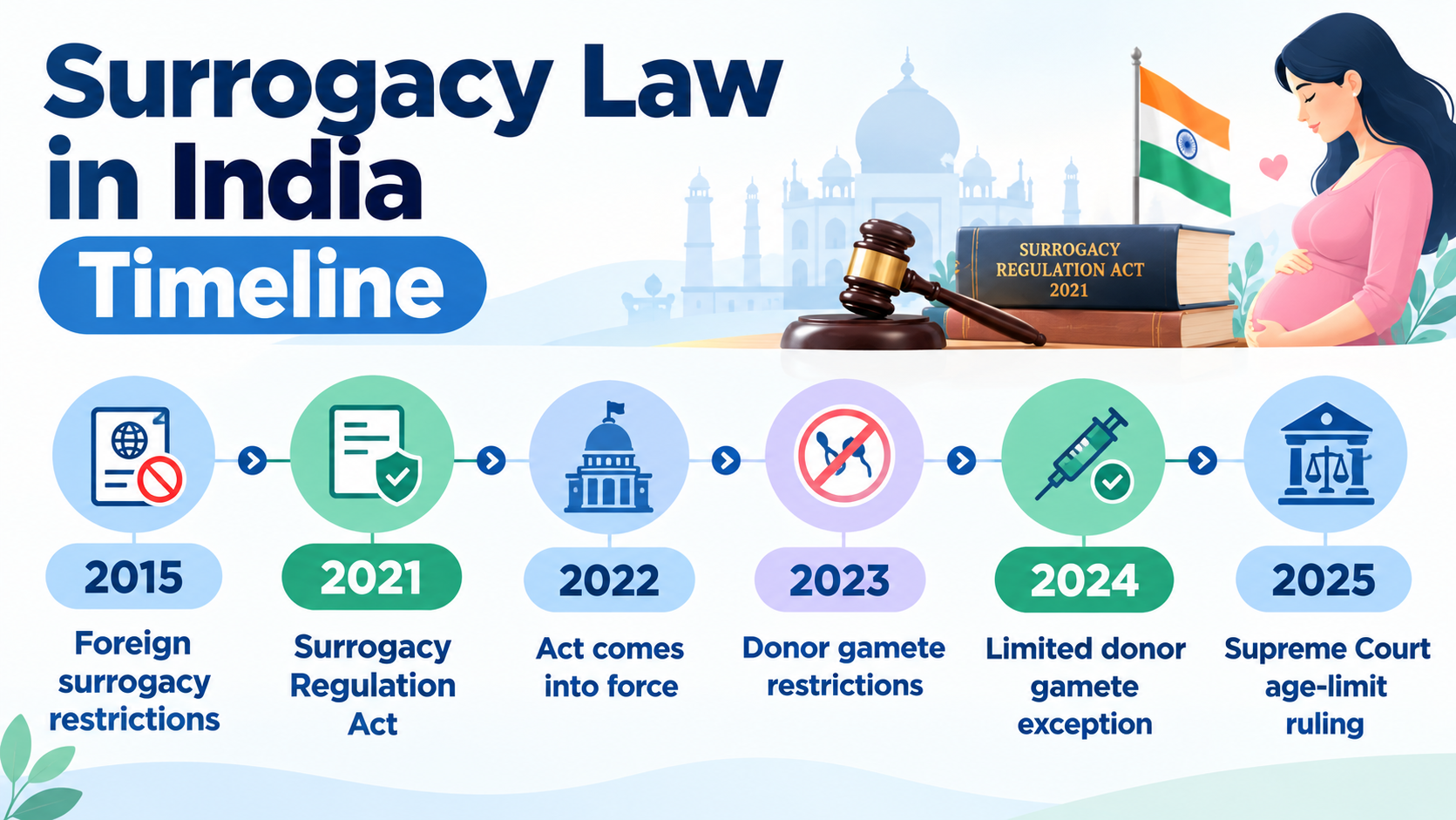
No. Only altruistic surrogacy is allowed. The surrogate mother can't be paid a fee. The intending couple covers her medical costs and other prescribed expenses, and buys insurance for her that lasts 36 months and covers complications after the birth.
The penalties for commercial surrogacy are severe: up to 10 years in prison and a fine of up to ₹10 lakh. That applies to doctors, clinics and agents, and to anyone who seeks or arranges it.
So if an agency tells you a "private arrangement" in India is possible for foreigners, please walk away. Whatever they're offering is illegal, puts the surrogate mother at risk, and could leave your child without legal parents or a passport.
Who Can Be a Surrogate Mother in India?
The rules for the surrogate are just as strict. She must:
- be aged 25 to 35;
- be married, or have been married, and have a child of her own;
- act as a surrogate only once in her lifetime;
- pass medical and psychological fitness checks;
- give written, informed consent, which she can withdraw before the embryo transfer.
She can't use her own eggs and can't be genetically related to the baby. Under the Act, she doesn't need to be a close relative of the couple.
Can Donor Eggs or Sperm Be Used in Surrogacy in India?
Yes, in limited cases, after the February 2024 amendment to the Surrogacy Rules.
In March 2023, the rules were changed to require the couple's own eggs and sperm. That left women with conditions such as MRKH syndrome, who can't produce eggs, with no route at all. The February 2024 amendment eased this: a married couple can now use one donor gamete, either an egg or sperm, if a District Medical Board certifies that one partner needs it for medical reasons. If both partners need donor gametes, surrogacy isn't permitted. A widow or divorcee must use her own eggs with donor sperm.
What Are the Options for Foreign Couples Who Come to India?
Surrogacy is closed to foreigners, but many fertility treatments aren't. Under the ART (Regulation) Act, 2021, foreign women aged 21 to 50 and men aged 21 to 55 can have assisted reproduction in India. For many couples, one of these is the right next step:
- IVF with your own eggs and sperm, for couples where the woman can carry a pregnancy. IVF treatment in India typically costs ₹1.5 to ₹2.5 lakh* per cycle, an indicative range that depends on your medical assessment and any additional treatment you need.
- ICSI, where sperm quality or quantity is the main problem.
- Donor egg IVF, for women with very low ovarian reserve or failed cycles with their own eggs. Donor egg IVF for international patients follows strict ART Act rules: donors are aged 23 to 35, anonymous, and donate only once.
- Embryo freezing, so you can complete egg collection in one trip and transfer later.
- Genetic screening (PGT), if repeated failure or miscarriage is the issue.
If surrogacy was suggested because of repeated failed transfers, it's worth getting a second opinion first. Sometimes the cause is something that can be investigated and treated, such as the uterine lining, an immune factor or embryo quality. At Delhi IVF, Dr. Anoop Gupta, Dr. Aastha Gupta and Dr. Vinnie Sandhu regularly review cases from overseas couples who were told surrogacy was their only option.
How Does Delhi IVF Handle Surrogacy Enquiries From Abroad?
Straightforwardly. When an international couple contacts us about surrogacy, we explain the law first, before anything else. If you're a foreign national without Indian origin, we won't take you down a surrogacy route, because it isn't legal for you.
What we will do is look carefully at your reports and history and tell you which treatments are genuinely open to you. Delhi IVF has been treating couples since 1993, delivered Delhi's first ICSI baby in 1996, and has welcomed patients from more than 66 countries. For eligible couples, including NRIs with Indian passports and OCI couples with Board approval, we manage altruistic surrogacy within the Act, from medical board certification to the final court order.
Talk to a Specialist Before You Plan
The law around surrogacy in India for foreigners is clear on the main point, but your own situation may have details that matter, such as citizenship, an OCI card, or a medical history that points to a different treatment.

