Male Infertility Causes and Tests: What Goes Wrong and How It Is Diagnosed

Roughly half of all fertility struggles involve a male factor, yet the man is often the last to be checked. The encouraging part is that identifying the exact reason is usually straightforward, and once the cause is clear, a significant share of cases can be effectively treated. This guide explains what can go wrong and, just as importantly, the tests doctors use to pinpoint it.

If you have already been diagnosed and want to understand your options, our main male infertility treatment guide covers those. Here, the focus is on causes and the diagnostic workup that identifies them.

CTA Block Background Image - 6a303cce14c3af548ded71f7

Find the Real Cause Behind Male Infertility

Low sperm count, poor motility, hormonal imbalances, varicocele, genetic conditions, and DNA damage can all affect fertility. Comprehensive testing helps identify the exact cause, allowing treatment to be tailored to your specific situation instead of relying on guesswork.

Call Now: +91-9810600235

What Causes Male Infertility?

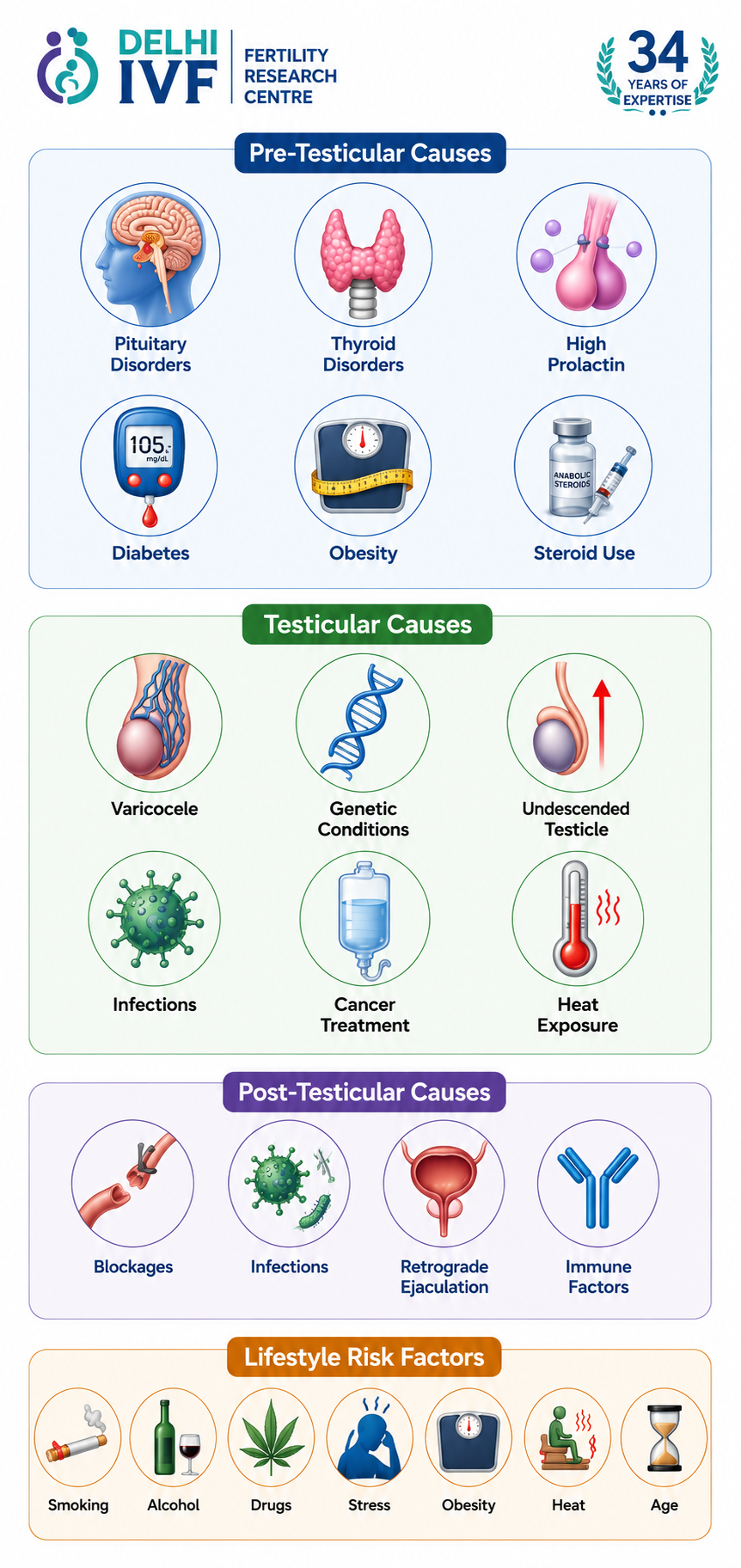
Doctors find it helpful to group the causes by where along the reproductive chain the problem sits. Sperm must be produced in good condition, mature properly, and then travel out. A fault at any of these three points can reduce fertility.

Pre-Testicular Causes: The Hormonal Triggers

Sperm production starts with a signal from the brain. The pituitary gland releases FSH and LH, which tell the testes to make sperm and testosterone. When that signalling is disturbed, production slows or stops. Common culprits include pituitary disorders, an underactive or overactive thyroid, raised prolactin, poorly controlled diabetes, obesity, and the use of anabolic steroids or testosterone supplements, which ironically shut down the body's own sperm production.

The good news is that many hormonal problems are among the most correctable, since the underlying imbalance can often be treated.

Testicular Causes: Problems with Sperm Production

This is where the sperm is actually made, and it is the most common site of trouble. Causes here include:

  1. Varicocele, a swelling of the veins around the testicle that warms the area and harms sperm over time. Roughly four in ten infertile men have one, and it is highly treatable.
  2. Genetic conditions such as Klinefelter syndrome and Y-chromosome microdeletions, which interfere with how sperm is produced.
  3. An undescended testicle in childhood, which can affect production years later, even after correction.
  4. Infections such as mumps caught after puberty, which can inflame and damage the testes.
  5. Cancer treatment, such as chemotherapy and radiation, can suppress or halt sperm production.
  6. Heat and toxins, including frequent saunas, industrial chemicals, and heavy metals.

These problems typically show up as a low count, weak movement, poor shape, or in severe cases, no sperm being produced at all.

Post-Testicular Causes: Blockages and Delivery Failures

Sometimes the testes make healthy sperm, but they cannot get out. A blockage anywhere along the tube that carries sperm, caused by a previous vasectomy, an infection, an injury, or a condition the man is born with, can stop sperm from reaching the semen entirely. Delivery can also fail when ejaculation pushes semen backward into the bladder rather than outward, or when the immune system makes antibodies that disable the sperm.

Lifestyle and Everyday Risk Factors

Layered on top of all of the above are habits and exposures that quietly lower sperm quality: smoking, heavy drinking, recreational drugs, being significantly overweight, chronic stress, and prolonged heat to the groin. Age plays a smaller role than in women, but sperm quality does gradually decline over the years. Because these factors are modifiable, addressing them is often the simplest first move.

Content Block Image - 6a33962c14c3af548def37f6

Understanding the Sperm Terms

A semen report often uses medical labels. In plain terms, oligospermia means a low sperm count, asthenospermia means weak sperm movement, teratospermia means too many abnormally shaped sperm, and azoospermia means no sperm in the semen at all. When low count, poor motility, and poor shape appear together, it is called OAT, the single most common pattern seen in infertile men.

Male Infertility Tests: How the Cause Is Found

Diagnosis works from the simplest test outward, and most answers come from the very first one, combined with a careful history.

Semen Analysis

The semen analysis is the cornerstone of male fertility testing. It measures the number of sperm, their motility, shape, and the volume and acidity of the sample. To get a reliable result, abstain from ejaculation for two to five days beforehand, and provide the sample at the laboratory so it can be examined fresh.

At Delhi IVF, samples are assessed against the latest WHO 2021 (sixth edition) standards. The lower reference limits are shown below.

Parameter WHO 2021 lower reference limit

Semen volume1.4 ml
Sperm concentration16 million per ml
Total sperm per ejaculate39 million
Total motility42%
Progressive motility30%
Normal morphology (shape)4%
Vitality (live sperm)54%

A result below these limits does not automatically mean infertility, and a result above them does not always guarantee fertility, which is why the report is always read alongside your history and your partner's assessment.

Why a Repeat Test Matters

Sperm takes about 74 days to develop, and a sample can be thrown off by a recent fever, stress, or heat. For that reason, a single abnormal result is never the final word. A second analysis, a few weeks later, confirms whether the finding is genuine or a one-off.

Hormone Profile

A blood test measuring testosterone, prolactin, thyroid function, and the pituitary hormones FSH and LH reveals whether a hormonal imbalance is behind the problem. The pattern is informative on its own. A high FSH usually points to the testes failing to produce sperm, whereas a low FSH suggests the signal from the brain is the issue.

Scrotal Ultrasound

An ultrasound of the scrotum looks for a varicocele, cysts, structural abnormalities, and signs of blockage. It is painless and quick, and it often confirms what a physical examination first suggests.

Genetic Testing

For men with a very low count or no sperm at all, genetic tests such as karyotyping, Y-chromosome microdeletion analysis, and screening for the cystic fibrosis gene are advised. These identify inherited causes and flag conditions that could be passed to a child, which is why genetic counselling goes hand in hand with the results.

Sperm DNA Fragmentation Test

This specialised test looks at how intact the sperm's DNA actually is. A man can have a perfectly normal semen analysis yet carry high DNA damage, which can quietly cause failed fertilisation, weak embryos, or repeated miscarriage. It is particularly useful for couples facing unexplained IVF failure or pregnancy loss.

Post-Ejaculatory Urine Test

When semen volume is very low or absent, a urine sample taken straight after ejaculation is checked for sperm. Finding sperm there confirms retrograde ejaculation, where semen travels into the bladder instead of leaving the body.

Cause and Test at a Glance

Suspected cause Common clue Test that confirms it

Hormonal imbalanceLow libido, low energyHormone blood profile
VaricoceleScrotal swellingScrotal ultrasound
Blockage (obstruction)No sperm, but normal hormones and testesUltrasound and genetic tests
Genetic conditionSevere low count or azoospermiaKaryotype, Y-microdeletion
Retrograde ejaculationVery low semen volumePost-ejaculatory urine test
Hidden DNA damageNormal report, but IVF failure or miscarriageDNA fragmentation test
CTA Block Background Image - 6a303cdc14c3af548ded71f9

Get Advanced Male Fertility Testing Under One Roof

A basic semen report does not always reveal the full picture. Advanced investigations can uncover hidden factors affecting fertilisation, embryo development, and pregnancy outcomes. Our specialists will recommend only the tests that are relevant to your case.

Speak with Our Fertility Experts: +91-9810600235

When Should a Man Get Tested?

A couple is generally advised to seek testing after twelve months of trying without success, or after six months if the female partner is over 35. Anyone with a known risk, such as a previous groin injury, an undescended testicle, cancer treatment, or a swelling in the scrotum, should be checked sooner rather than later. Because a male and female factor often coexist, testing both partners together is always the wiser route.

Real Families. Real Stories.

Our Team

Meet the specialists behind your baby dream

Senior IVF consultants, embryologists and gynaecologists working as one team.

Browse All Our Specialists
Dr. Anoop Gupta

Dr. Anoop Gupta

Director & IVF Specialist, Delhi IVF & Fertility Research Centre

⭐34+ Years Experience
View Profile
Dr. Aastha Gupta

Dr. Aastha Gupta

Infertility Specialist, Obs & Gynae (Gold Medalist)

⭐15+ Years Experience
View Profile
Mrs. Alka Gupta

Mrs. Alka Gupta

Chief Embryologist, Delhi IVF & Fertility Research Centre

⭐32+ Years Experience
View Profile
Dr. Mannan Gupta

Dr. Mannan Gupta

MBBS & MS – Obstetrics & Gynaecology, Maulana Azad Medical College

⭐10+ Years Experience
View Profile
Dr. Vinnie Sandhu

Dr. Vinnie Sandhu

MD (Moscow), Obstetrics & Gynaecology

⭐30+ Years Experience
View Profile

Why Choose Delhi IVF for Male Infertility Diagnosis

A precise diagnosis depends on a laboratory that can do more than count sperm. Delhi IVF and Fertility Research Centre operates a dedicated andrology laboratory that adheres to WHO 2021 standards, offering advanced tests such as DNA fragmentation and genetic screening under one roof.

  1. Semen analysis and andrology testing to the current WHO criteria
  2. Hormonal, ultrasound, genetic, and DNA fragmentation testing in one place
  3. Genetic counselling where an inherited cause is found
  4. Assessment of both partners together, so nothing is missed
  5. Guidance led by Dr. Anoop Gupta, Director and IVF Specialist

Our Success Stories

25000 Happy Couples with real stories from Delhi IVF Patients,

google logo
4.5
/5
Based on 1000+ reviews

What our patient's are saying

Updated recently • Verified reviews

I am very happy with my wife by listening news of getting 2 babies in womb after ultrasound. Some time ago we were panicked but now we are very happy. Its a great news for us. We are thankful to Delhi IVF & Fertility Centre.

Manish Gupta
IVF with ICSI

I am so happy to share that my IVF result came positive. Thank you Delhi IVF and Dr Anoop Gupta and Dr Aastha Gupta. The team here is amazing very professional, kind and encouraging. Thank you for giving us hope and happiness truly the best clinic for IVF.

Deepa Kumari
IVF with ICSI

Started with great first initial virtual with Dr Anoop Gupta ,Dr Aastha and team especially Beautiful Preeti ,explained everything perfectly with clear cost of treatment and services provided .Managed to come to the Centre from London in December greeted with nice supportive staff team ,as we had limited time ,all the tests and treatment started quite quickly and continued nicely till the end of.Very impressive experience to be here and feel blessed already Thank you for everything

Navneet Kaur
IUI Procedure

Delhi IVF is the most trusted place, Dr. Anoop Gupta and team, as well as all the staffs are very kind and knowledgeable. Thank you! I got pregnant at first try. I am very happy now. I don't get word to express my feelings and how thankful I am for all Delhi IVF Doctors and staffs.Thank you again.

Angle Thar
Egg Freezing

We are so happy to share that after trying from 11 years we conceived from Delhi IVF in first cycle I am very happy I work in TV9 as a journalist and I came here through reference and then first IVF successful with twins I will recommend everyone to come here for any problem with conceiving.

Rohit Nirwal
IVF with ICSI

Today was my first visit to Delhi IVF centre in srinagar and i felt very good after coming here.The treatment was excellent.I want to tell everyone that if there is any good IVF centre in kashmir.it is only one Delhi IVF centre where Dr.Anoop Gupta provides treatment thank you so much.

Manzoor Paul
IVF with ICSI

My partner and I highly recommend the Dr. Anoop Gupta & his clinic Delhi IVF & fertility centre!!! Our experience was absolutely fantastic; the nurses are very kind, helpful and extremely talented across the whole range from doctors, nurses, and administrators.

Baabul Kumar
IVF with ICSI

I am very happy and my experience with Delhi IVF center is very nice. Now I'll get my 2 baby from the treatment in Delhi IVF. Very good and helpful staff. And I have no words for Dr. Anoop Gupta, he is very kind and well caring.Thank you Dr. Gupta and all staff members.

Ravi Prakash
IVF with ICSI

It's an amazing IVF centre, all doctors and staff are very supportive. We have been trying since a very long time, finally got success, all thanks to Delhi IVF.

Kundan Sinha
Egg Freezing

Very good experience after visiting and meeting with Dr. Anoop gupta ji and his team. Before visiting here we had lost all hopes of conceiving baby but here we got confidance again and successfully gives birth to beautiful princess.

Dinesh Chauhan
IVF with ICSI

I am short of words when it comes to thanking Delhi IVF for what it has given me. I had been trying for 8 yrs and this clinic has given me the best gift ever. The team of doctors led by Dr Gupta and Dr Vinny are very helpful and caring.

Anubha Singh
IVF with ICSI

Dr Gupta is an amazing doctor. I strongly advise to all friends and family who are struggling to become parents. You are assured to have a very satisfying experience and you could faith him fully to make the best result for you.

Rohit Lakra
IVF with ICSI

I am very happy with my wife by listening news of getting 2 babies in womb after ultrasound. Some time ago we were panicked but now we are very happy. Its a great news for us. We are thankful to Delhi IVF & Fertility Centre.

Manish Gupta
IVF with ICSI

I am so happy to share that my IVF result came positive. Thank you Delhi IVF and Dr Anoop Gupta and Dr Aastha Gupta. The team here is amazing very professional, kind and encouraging. Thank you for giving us hope and happiness truly the best clinic for IVF.

Deepa Kumari
IVF with ICSI

Frequently Asked Questions

Q1: How should I prepare for a semen analysis test?

Abstain from ejaculation for two to five days before the test, avoid alcohol beforehand, and collect the sample at the laboratory. Following these steps gives the most accurate and reliable semen analysis result.

Q2: What are the normal semen analysis values under WHO 2021?

According to the WHO 2021 criteria, the lower reference limits are a volume of 1.4 mL, a concentration of 16 million per mL, 42% total motility, 30% progressive motility, and 4% normal shape.

Q3: Can a man be infertile with a normal semen analysis?

Yes. A normal semen analysis can still hide problems like high sperm DNA fragmentation, which a standard test does not detect. This is why unexplained IVF failure or miscarriage warrants further specialised testing.

Q4: What does a high FSH level mean in male infertility?

A raised FSH level usually signals that the testes are struggling to produce sperm, pointing toward a testicular cause. A low FSH instead suggests the problem lies in hormonal signalling from the brain.

Q5: Which test detects a varicocele?

A scrotal ultrasound is the main test used to detect a varicocele, the enlarged scrotal veins that can impair sperm production. A physical examination by the doctor often raises the first suspicion.

Q6: When is genetic testing recommended for male infertility?

Genetic testing is advised for men with severe low sperm count or azoospermia. Tests like karyotyping and Y-chromosome microdeletion analysis check for inherited conditions that could affect sperm production or be passed to children.

Q7: What test diagnoses retrograde ejaculation?

Retrograde ejaculation is diagnosed with a post-ejaculatory urine test. If sperm appear in the urine sample after orgasm, it confirms that semen is flowing backward into the bladder instead of outward.

Q8: How do doctors tell obstructive from non-obstructive azoospermia?

Doctors use hormone levels, testicular size, and ultrasound to tell them apart. Normal FSH with normal testes suggests a blockage, while raised FSH with small testes points to a sperm production failure.

Q9: Why does a semen test need to be repeated?

Sperm production runs on a roughly 74-day cycle, and results swing with illness, stress, and heat. So a single abnormal semen analysis is repeated a few weeks later to confirm the finding.

Q10: When should a couple get male fertility testing done?

A couple should seek male fertility testing after twelve months of trying without success, or after six months if the female partner is over 35. Known risk factors justify testing sooner.


CTA Block Background Image - 6a303ce214c3af548ded71fb

Trusted Male Infertility Diagnosis Since 1993

Delhi IVF combines WHO-standard semen analysis, hormonal evaluation, ultrasound imaging, genetic testing, and DNA fragmentation assessment to provide a complete understanding of male fertility health. Accurate diagnosis is the first step toward successful treatment.

Call Delhi IVF Today: +91-9810600235