
The short answer: the IVF cost in India for Ethiopian couples is typically ₹1.5 to ₹2.5 lakh* per cycle, which is roughly 253,000 to 422,000 birr* at October 2026 exchange rates. Medicines, tests, ICSI, embryo freezing or donor eggs can add to that, so most couples should budget for the full picture rather than the headline price.
That full picture, item by item and in birr, is what this article sets out. It also covers how donor eggs work for foreign couples under Indian law, and what to bring so you aren't paying twice for tests or caught out at the airport. Couples still weighing up IVF in India for Ethiopian patients usually want the numbers first, so that's where we start.
Money is often the part couples find hardest to talk about, and the part where vague answers cause the most worry. So we've tried to be specific, show our working, and flag where a number depends on your own treatment.
All birr figures use a rate of 1 Indian rupee = about 1.69 birr (6 October 2026) and are rounded. The birr has moved a lot since it was floated in 2024, so check the rate on the day you pay.
Key Facts at a Glance
| Question | Answer |
| Standard IVF cycle at Delhi IVF | ₹1.5 to ₹2.5 lakh* (about 253,000 to 422,000 birr*) |
| Biggest extra cost | Stimulation medicines, ₹30,000 to ₹1 lakh* (about 51,000 to 169,000 birr*) |
| Can Ethiopian couples use donor eggs in India? | Yes, under the ART (Regulation) Act, 2021 |
| Can you bring your own egg donor? | No. Donors must be anonymous and come through a registered ART bank |
| Can you pay in birr? | No. Fees are in Indian rupees, paid by card, bank transfer or exchanged cash |
| Written quote before travel? | Yes, after your video consultation |
- Costs are indicative. Your final cost depends on your medical assessment, and additional tests, medicines or treatments may be needed. It is confirmed in your written estimate.
How Much Does IVF Cost in India in Ethiopian Birr?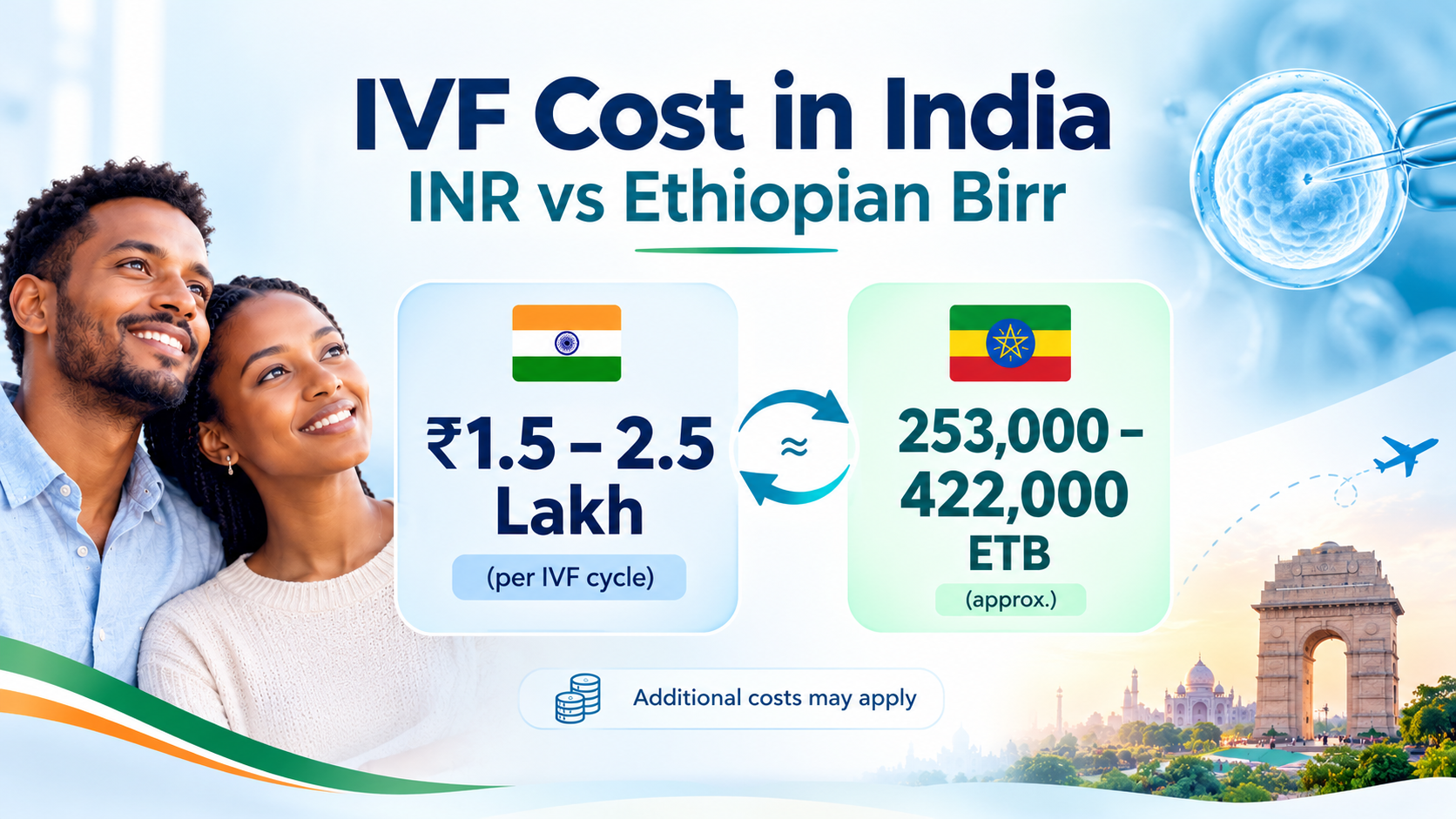
A standard IVF cycle at Delhi IVF costs ₹1.5 to ₹2.5 lakh*, or roughly 253,000 to 422,000 birr*. Where you fall in that range depends mainly on your age, your egg reserve, the stimulation protocol and whether ICSI is needed.
Here's how the main costs break down. Each line follows the same structure as our full IVF cost breakdown for India, converted into birr.
| Item | Indian rupees | Ethiopian birr (approx.) |
| IVF cycle (egg collection, lab, embryo culture, transfer, sedation) | ₹1,50,000 to ₹2,50,000* | 253,000 to 422,000* |
| Pre-treatment tests, if not done in Ethiopia | ₹15,000 to ₹40,000* | 25,000 to 68,000* |
| Stimulation medicines | ₹30,000 to ₹1,00,000* | 51,000 to 169,000* |
| ICSI, for male factor infertility | ₹15,000 to ₹30,000* | 25,000 to 51,000* |
| PGT-A embryo screening, up to 8 embryos (only if advised) | ₹50,000 to ₹1,20,000* | 84,000 to 203,000* |
| PGT-M for a known genetic condition (only if advised) | ₹80,000 to ₹2,00,000* | 135,000 to 338,000* |
| Embryo freezing, storage and frozen embryo transfer | Quoted after consultation, only if needed | Quoted after consultation |
- Costs are indicative. Your final cost depends on your medical assessment, and additional tests, medicines or treatments may be needed. It is confirmed in your written estimate.
Why do quotes vary so much?
Mostly because of medicines. A 28-year-old with a good egg reserve may need a modest dose for ten days. A 39-year-old with a low AMH may need higher doses for longer. That one difference can move your total by tens of thousands of birr, which is why we only give a firm quote after reviewing your reports.
What is usually not included in the IVF price?
At most clinics, including ours, the headline cycle price doesn't cover:
- the first consultation and pre-cycle tests;
- stimulation medicines and medicines after the transfer;
- ICSI, embryo freezing, genetic screening or donor eggs, if you need them;
- a frozen embryo transfer on a later trip.
Always ask any clinic for a written list of what is and isn't included. Two quotes that look very different can turn out to be almost the same once the extras are added.
Is IVF Cheaper in India Than in Ethiopia?
Not always, and it's worth being honest about that.
St. Paul's Hospital Millennium Medical College in Addis Ababa, the first public facility in Ethiopia to offer IVF, published fees of 25,000 to 70,000 birr in its subsidised clinic and 60,000 to 120,000 birr in its private wing on a page last updated in 2020. Those figures pre-date the 2024 birr float, so today's prices are likely to be higher. The same page reported waits of up to eight months for a first public appointment, and a further four to six months before advanced treatment.
So for a straightforward case, staying in Addis may well cost less. Couples who travel to India usually do so for other reasons:
- Time. Private treatment in Delhi isn't tied to a public waiting list, so it can start as soon as your tests and visa are ready.
- Complex cases. Repeated failed cycles, very low egg reserve, severe male factor infertility or the need for genetic screening.
- Donor eggs. Access to an established, regulated donor programme.
- Experience. Delhi IVF has been treating couples since 1993, delivered Delhi's first ICSI baby in 1996, and has helped bring more than 25,000 babies into the world.
What Is the Total Budget for IVF in India, Including Travel?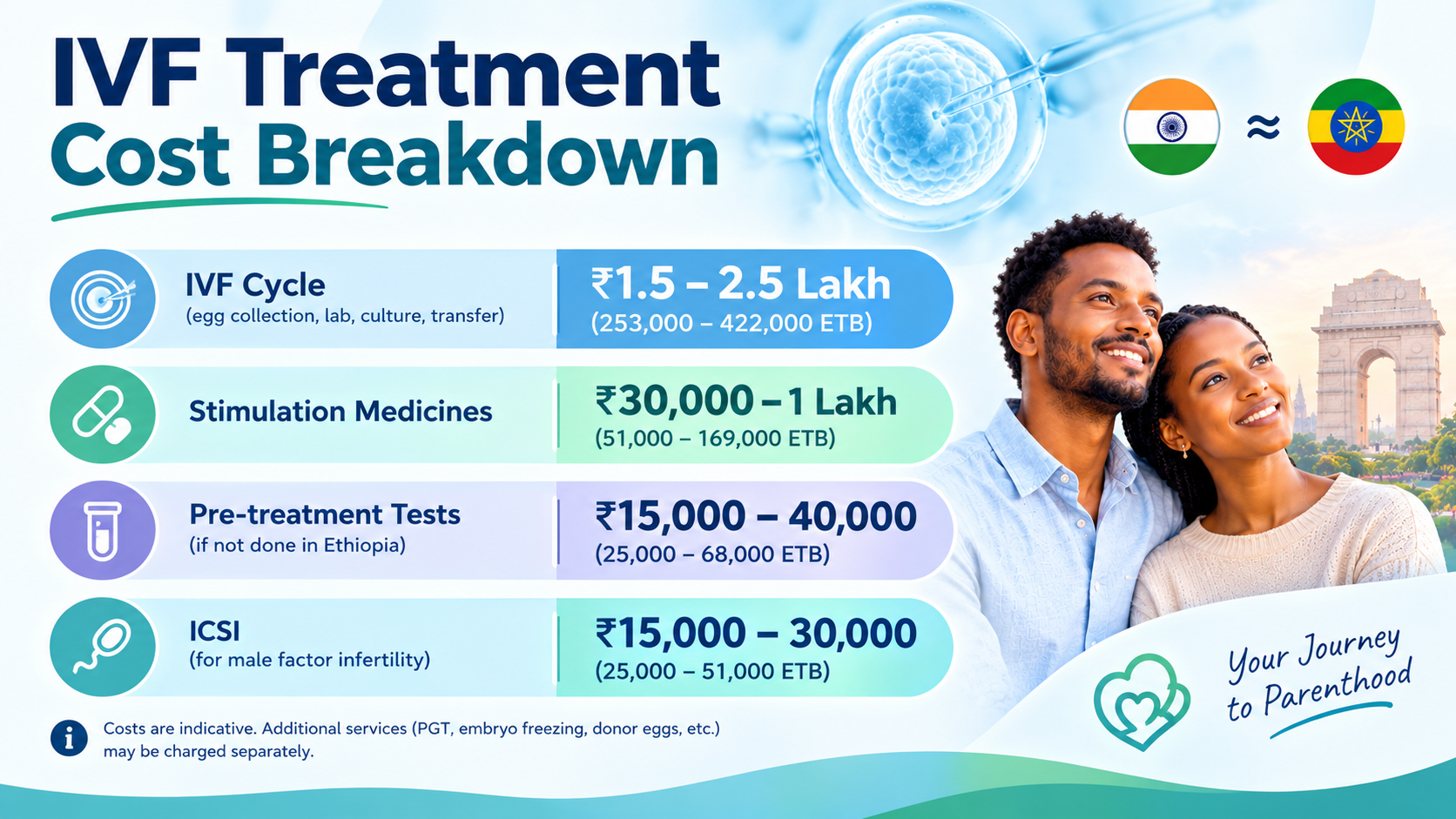
For one trip with a fresh embryo transfer, the treatment itself is the largest and most predictable part of the budget:
| Cost | Approximate range |
| IVF cycle, stimulation medicines and ICSI | ₹1,95,000 to ₹3,80,000* (about 330,000 to 642,000 birr*) |
- Costs are indicative. Your final cost depends on your medical assessment, and additional tests, medicines, or treatments may be needed. It is confirmed in your written estimate.
On top of that, plan for the costs of the trip itself. These vary too much with season and personal choice to give one honest figure, so price each one for your own dates:
- Return flights for two. Ethiopian Airlines advertises fares from Ethiopia to India starting at around 88,000 birr, but fares for your exact dates, especially with a changeable ticket, are usually higher. If his test results are normal, your husband may need only three to four working days in Delhi, which can lower his travel and accommodation costs, though he's welcome to stay throughout.
- Accommodation. Three to six weeks for a full cycle with a fresh transfer, depending on your medical condition, or about two weeks plus a shorter second trip if your embryos are frozen. Delhi IVF also has in-house accommodation options set aside for international patients. They're economical, and you can ask our team for photos and prices before you book anything.
- Visas. Medical and Medical Attendant visa fees, paid to the Embassy of India in Addis Ababa.
- Yellow fever vaccination, if you don't already have a valid certificate.
- Daily costs. Food, local taxis and an Indian SIM card.
Flight choices affect the budget more than people expect. A changeable ticket costs a little more upfront but far less than a rebooking, and the flights, visa, and stay plan from Addis Ababa show how long each stage of treatment keeps you in Delhi.
Can Ethiopian Couples Use Donor Eggs in India?
Yes. Foreign couples can have donor egg IVF at a registered clinic in India, under the Assisted Reproductive Technology (Regulation) Act, 2021. Women aged 21 to 50 and men aged 21 to 55 can access treatment.
Donor eggs are often recommended when:
- a woman's egg reserve is very low, or her ovaries no longer produce eggs;
- several IVF cycles with her own eggs haven't produced good embryos;
- she's in her mid-forties or older;
- she carries a genetic condition she doesn't want to pass on.
What are the rules for egg donors in India?
The ART Act sets strict conditions, and they protect both the donor and you:
- the donor must be aged 23 to 35;
- she can donate only once in her lifetime;
- no more than seven eggs can be retrieved from her;
- she stays anonymous, and you won't know her identity;
- the commissioning couple pays for her insurance cover.
You may read about a February 2024 rule change on donor eggs and sperm. That amendment applies to surrogacy, not to standard donor egg IVF, which the ART Act already permits. Matching, consent, and timelines all follow the same donor egg rules for international patients that apply to every overseas couple.
Can we bring a relative or friend from Ethiopia to donate eggs?
No. Under the ART Act, donors must be anonymous and recruited through a registered ART bank, so a known donor, such as a sister or friend, isn't allowed.
How are donors matched for Ethiopian couples?
This is a question many couples ask quietly, and it deserves a straight answer. Most egg donors in India are of Indian origin. Donors are usually matched on blood group and on physical characteristics such as height, build, and complexion, as closely as the available profiles allow. Your doctor will talk you through what's realistic before you commit, so there are no surprises.
How much does donor egg IVF cost in India?
Donor egg IVF costs more than a standard cycle, because it includes the donor's screening, medicines, egg collection, and the insurance the law requires you to buy for her. The exact figure depends on your plan, so it's quoted in writing after your consultation. It can also change your travel plans, as the donor's cycle has to be timed with yours.
How Do You Pay for IVF in India From Ethiopia?
Fees in India are charged in Indian rupees. Birr isn't easily exchanged in India, so plan.
- International bank transfer to the clinic is usually the simplest way to pay larger amounts. Ask for the clinic's bank details in writing, directly from the clinic.
- Visa and Mastercard cards are widely accepted in Delhi. Tell your bank before you travel so payments aren't blocked.
- US dollars in cash are easy to exchange in Delhi, and many couples bring some for day-to-day costs.
Check the cash rules at both ends. Ethiopia limits how much foreign currency travellers can take out, so confirm the current National Bank of Ethiopia rules before you fly. On arrival in India, you must declare foreign currency on a Currency Declaration Form if you're carrying more than USD 5,000 in cash, or more than USD 10,000 in total foreign exchange.
What Should You Bring to Keep IVF Costs Down?
The right paperwork saves real money. Every test we don't need to repeat is a cost you don't pay twice.
- Recent test results from Ethiopia. AMH, thyroid and prolactin, infection screening, and the husband's semen analysis, ideally from the last three to six months. Ask us which ones are still valid by your travel date.
- Reports from any earlier IVF cycles. Medicine doses, egg numbers, embryo grades, and transfer notes help us avoid repeating a protocol that didn't work.
- Scan and surgery reports. Ultrasounds, HSG, hysteroscopy or laparoscopy notes, so we don't redo investigations.
- Your marriage certificate. It's needed for the consent forms under the ART Act. Bring the original, a copy, and a certified English translation if it's in Amharic.
- The written quote. Bring the estimate we send after your consultation, so everyone is working from the same numbers.
- A way to pay. A card that works abroad, your bank's transfer details, and some US dollars in cash.
Why Do Ethiopian Couples Choose Delhi IVF?
Because the plan and the price are nearly clear before you get on a plane. Every overseas couple starts with a video consultation with Dr. Anoop Gupta or Dr. Aastha Gupta, followed by a written treatment plan and cost estimate.
From there, your care sits with senior specialists, including Dr. Vinnie Sandhu, while Mrs. Alka Gupta, our Chief Embryologist, oversees the laboratory where your eggs and embryos are handled. Delhi IVF has welcomed patients from more than 66 countries, has seen more than 5,000 IVF babies born to families from across Africa, and stays in touch after you go home, through your pregnancy test and beyond.
Get a Written Estimate Before You Plan
The most useful thing you can do now is send us your reports. We'll tell you what treatment is likely to suit you, which extras you probably won't need, and what the full cost is likely to be, in rupees and in birr.

