
The short answer: for IVF in India from Ethiopia, most couples fly direct from Addis Ababa to Delhi in about six hours, travel on an Indian Medical visa issued by the embassy in Addis Ababa, and plan to stay three to six weeks for a full IVF cycle with a fresh embryo transfer, depending on the woman's medical condition. If your embryos are frozen for a later transfer, the first trip can be closer to two weeks.
This article focuses on the practical side: flights, visas, timing, and packing- the things that turn IVF in India for Ethiopian couples from an idea into a booked trip.
Couples travelling from abroad tell us the same thing again and again: the treatment itself is rarely the hardest part to plan. It's everything around it. Which week to fly, how long to book a room for, whether a husband can travel on the same visa, what to do if the period comes early. This is the plan we'd give a friend.
Key Facts at a Glance
| Question | Answer |
| Direct flights | Ethiopian Airlines, Addis Ababa (ADD) to Delhi (DEL), about 5 hours 30 minutes to 6 hours, usually twice a day |
| Time difference | Delhi is 2 hours 30 minutes ahead of Addis Ababa |
| Visa | Regular Indian Medical visa from the Embassy of India in Addis Ababa. Ethiopia isn't on the e-Visa list |
| Typical stay, fresh transfer | Usually 3 to 6 weeks, depending on your medical condition |
| Typical stay, freeze-all cycle | About 14 to 16 days, then a shorter second trip |
| Husband's stay | As little as 3 to 4 working days if his test results are normal |
| Best time to arrive | Day 1 to 3 of your period |
| Health requirement | Original yellow fever vaccination certificate, given at least 10 days before arrival |
| Language | Consultations and reports are in English |
| IVF cost at Delhi IVF | ₹1.5 to ₹2.5 lakh* per cycle, about 253,000 to 422,000 birr* |
- Costs are indicative. Your final cost depends on your medical assessment, and you may need additional tests, medicines, or treatments. It is confirmed in your written estimate. Birr figures use 1 Indian rupee = about 1.69 birr (6 October 2026).
Why Do Ethiopian Couples Travel to India for IVF?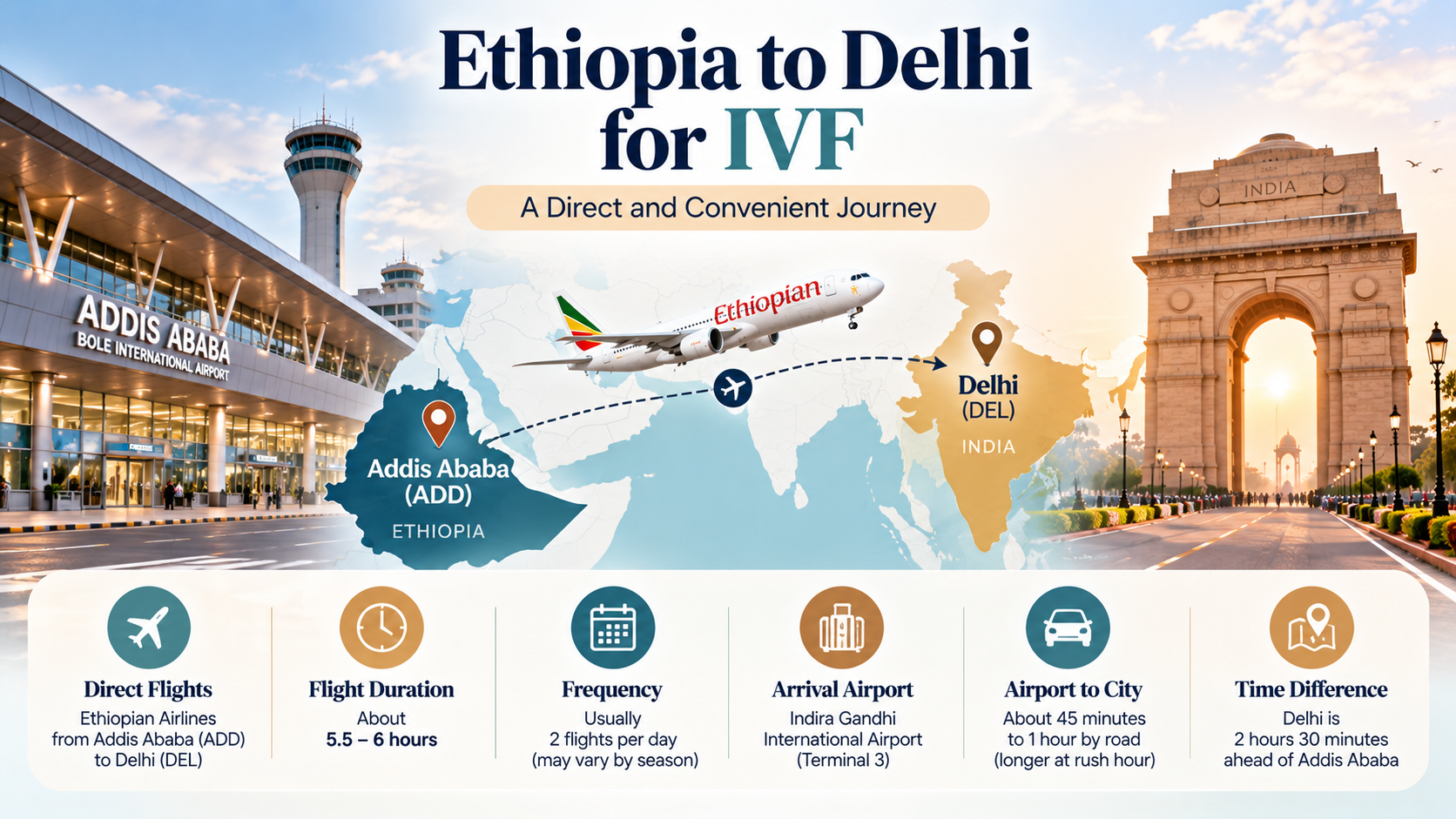
Mostly because of choice, cost, and experience. IVF services in Ethiopia have grown, but there are still only a few centres, all of them in Addis Ababa. Couples with complex cases, such as repeated failed cycles, low egg reserve or severe male factor infertility, often want a clinic that sees those cases every week.
India offers that at a cost well below the UK, Europe or the Gulf, with a short direct flight and a medical visa issued right there in Addis Ababa. Delhi IVF & Fertility Research Centre has been treating couples since 1993, delivered Delhi's first ICSI baby in 1996, and has welcomed patients from more than 66 countries. That experience shapes how we deliver IVF treatment in India for international patients, from the first video call to follow-up after you fly home.
How Do You Fly From Ethiopia to Delhi?
Ethiopian Airlines flies direct from Addis Ababa Bole International Airport to Indira Gandhi International Airport in Delhi, arriving at Terminal 3. The flight takes around five and a half to six hours. The route normally has two flights a day, ET688 and ET686, one leaving Addis in the afternoon and one late at night, though timings change with the season, so check the schedule when you book.
A few tips from couples who've done the trip:
- Take the overnight flight if you can. You land in Delhi in the morning, which leaves the day free to rest and settle in before your first appointment.
- Book a flexible or changeable ticket. IVF dates move. Your egg collection can shift by a day or two depending on how your follicles grow, and a rigid ticket can be expensive to change.
- Avoid tight connections home. If you're flying on from Addis to another city in Ethiopia, leave room for delays.
- Watch for winter fog. From late December to January, morning fog in Delhi sometimes delays flights. Build in a spare day around your return.
Delhi IVF's Central Delhi centre at Mandi House is usually 45 minutes to an hour from the airport by road, longer at rush hour. Prepaid taxis and app-based cabs are available outside the arrivals hall at Terminal 3.
Which Visa Do You Need for IVF in India?
Ethiopian citizens need a regular Indian Medical visa, applied for through the Embassy of India in Addis Ababa. This catches a lot of couples out, because many websites talk about India's online e-Medical visa. Ethiopia isn't currently on the e-Visa eligibility list, so the online route isn't available to Ethiopian passport holders.
Here's what to expect:
- Where to apply. The Embassy of India in Addis Ababa, near the Bel Air Hotel in Arada sub-city, issues medical visas to Ethiopian nationals. Visa submissions are taken on weekday mornings, so check the embassy's website for current hours and forms before you go.
- What to bring. Your passport, completed application, photographs, and a letter from the Indian clinic confirming your treatment and its expected length. Delhi IVF issues this letter once your plan is agreed.
- How long it takes. Allow at least a week, and apply well before your target cycle. Visa fees are non-refundable.
- Registration in India. If your visa is valid for more than 180 days, you must register with the Foreigners Regional Registration Office within 14 days of arriving. Most IVF trips are much shorter, but check what your visa says.
Couples who have read about the e-Medical visa process for IVF used by other nationalities are often surprised by this, so plan for an embassy visit rather than an online form.
Can a husband travel on the same visa?
No, each person needs their own visa. Your husband, or another family member, applies for a Medical Attendant visa linked to your Medical visa. A maximum of two attendants are allowed per patient. Apply for both visas together, with the same clinic letter, so the dates match.
Do you need a yellow fever certificate?
Yes. This is the step Ethiopian travellers most often forget. India requires travellers arriving from countries with a risk of yellow fever, including Ethiopia, to carry an original yellow fever vaccination certificate. Photocopies and digital copies aren't accepted.
The vaccine must be given at least 10 days before you arrive in India, because the certificate only becomes valid after that. Without a valid certificate, you can be quarantined on arrival for up to six days, which could cost you your whole IVF cycle. Your husband and anyone else travelling with you need one too.
How Long Do You Need to Stay in India for IVF?
Most couples from Ethiopia should plan for three to six weeks in Delhi for a full cycle with a fresh embryo transfer. Where you fall in that range depends on the woman's medical condition: some women need tests or a minor procedure before stimulation can start, and some respond more slowly to the medicines. If your embryos are frozen for a later transfer, the first trip is shorter.
A fresh-transfer IVF trip (the shortest common timeline, about three weeks)
| Days in Delhi | What happens |
| Day 1 to 2 | Arrive on day 1 to 3 of your period. Consultation, scan, and blood tests. Husband's semen analysis |
| Day 2 to 12 | Daily hormone injections to stimulate the ovaries, with a scan every 2 to 3 days |
| Around day 12 to 14 | Trigger injection, then egg collection 34 to 36 hours later under light anaesthesia. Husband's sample is collected that morning, or arranged earlier if he has already flown home |
| Day 14 to 19 | Embryos grow in the laboratory for 3 to 5 days |
| Around day 17 to 19 | Embryo transfer, a short procedure usually done without anaesthesia |
| 1 to 2 days later | Rest, then fly home |
If your doctor plans extra steps, the same stages simply take longer, which is why three to six weeks is the safer range to plan around.
Your pregnancy blood test is done about 14 days after the transfer. You don't have to stay in India for it. Most Ethiopian couples take the test at a laboratory in Addis and share the result with us by WhatsApp or email.
A freeze-all trip (about 14 to 16 days, then a second visit)
Sometimes it's better to freeze all the embryos and transfer later, for example, when genetic screening is planned, the lining of the womb isn't ready, or there's a risk of ovarian hyperstimulation. In that case, the first trip ends a day or two after egg collection.
The second trip, for a frozen embryo transfer, is shorter, usually 5 to 7 days in Delhi. Some couples prefer this approach anyway, because it splits the time away from work and family into two shorter blocks.
How long does your husband need to stay?
Your husband doesn't always need to stay for the whole treatment. If all his test results are normal, his part can take as little as three to four working days in Delhi, and your doctor will explain how and when his sample is collected. He's very welcome to stay for the entire process if he's able to.
What if my period comes before I fly?
Don't worry, this happens often. Message the clinic as soon as it starts. Depending on the day, your doctor will either adjust your start date or plan the trip around your next cycle.
What Should You Do Before You Leave Ethiopia?
A little preparation at home saves days in Delhi.
- Book a video consultation first. Dr. Anoop Gupta or Dr. Aastha Gupta will review your history and tell you which tests to finish at home, so you arrive ready to start.
- Do the basic tests in Addis. These usually include AMH, thyroid, and prolactin, a pelvic ultrasound, the husband's semen analysis, and screening for HIV, hepatitis B and C, and syphilis. Ask the clinic which results are still valid by your travel date.
- Gather your old reports. Previous IVF summaries, embryology reports, surgery notes, and scans help the team plan your protocol properly.
- Get your visa letter and yellow fever certificate. The clinic issues the letter you'll take to the Indian Embassy with your Medical visa application. Have the yellow fever vaccine at least 10 days before you fly, and keep the original certificate with your passport.
- Bring your marriage certificate. India's ART Act 2021 treats a commissioning couple as a married couple, so the clinic will ask to see proof. Bring the original and a copy, plus a certified English translation if the certificate is in Amharic.
- Sort out money. Cards are widely accepted in Delhi, and US dollars are easy to exchange. Let your bank know you'll be using your card abroad.
What Should You Pack for an IVF Trip to Delhi?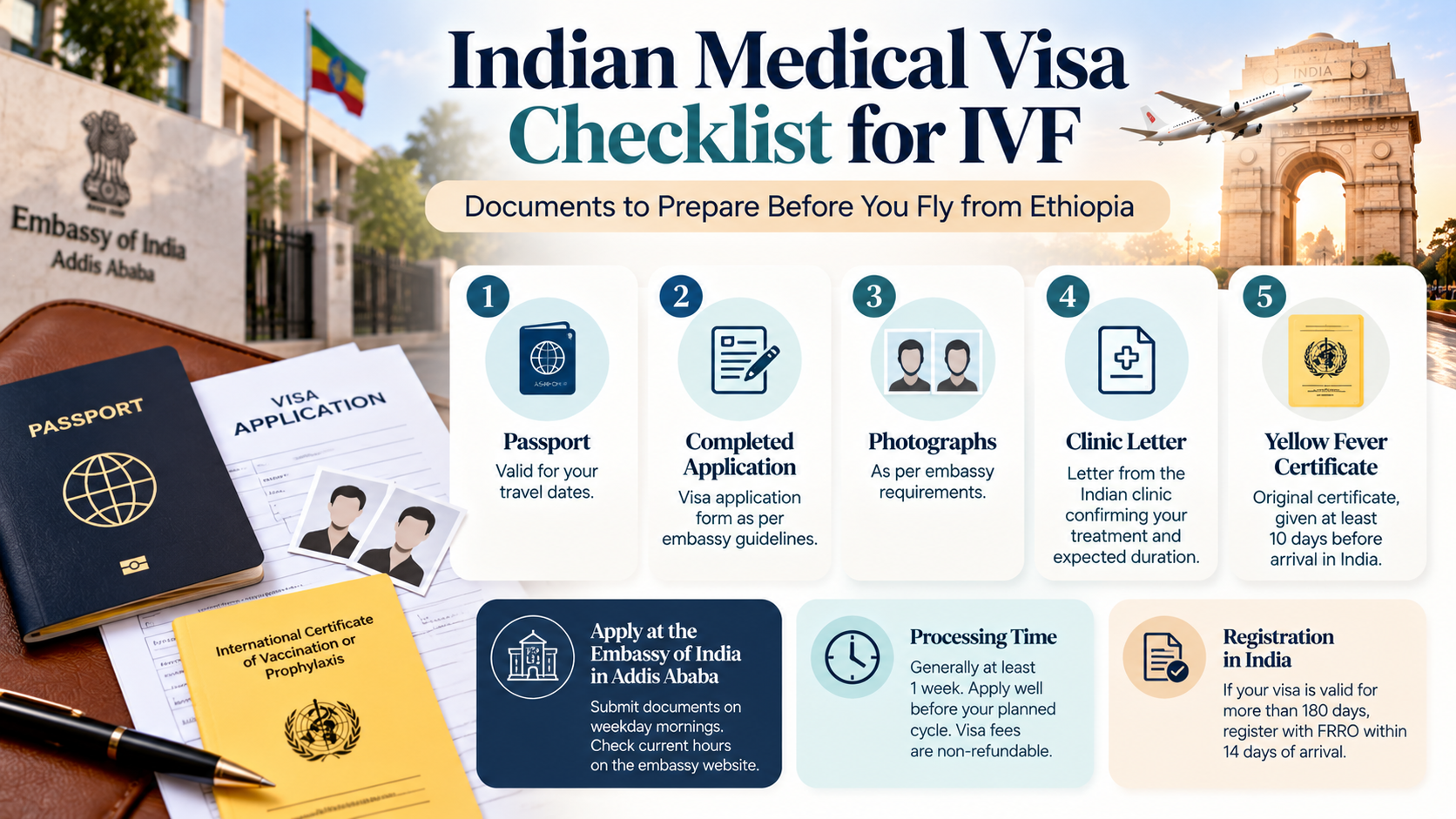
- Passport with your Medical visa, original yellow fever certificate, and return ticket
- All medical reports, on paper and saved on your phone
- Any medicines you take regularly, with prescriptions
- Comfortable, loose clothing for appointment days
- Clothes for the season: Delhi is very hot from April to June, wet during the monsoon in July and August, and surprisingly cold in December and January
- A small cool bag, in case you need to carry injections between your room and the clinic
- An Indian SIM card, which you can buy at the airport with your passport
Where Do Ethiopian Couples Stay in Delhi?
Many couples stay close to the clinic, so the regular morning scans don't mean a long drive through traffic. A kitchen helps if you'd like to cook familiar food during a stay of several weeks.
Delhi IVF also has in-house accommodation options set aside for international patients. They're economical, and you can ask our team for photos and prices before you book anything.
Delhi IVF has centres at Mandi House in Central Delhi and Lajpat Nagar in South Delhi, so look for somewhere within a short drive of the one where you'll be treated.
Can You Use Donor Eggs or Sperm in India as an Ethiopian Couple?
Yes. Under India's ART (Regulation) Act, 2021, foreign couples can use donor eggs or sperm at a registered clinic. Women aged 21 to 50 and men aged 21 to 55 can access treatment. Egg donors in India must be aged 23 to 35, stay anonymous, and donate only once in their lifetime, which means you can't bring a relative to donate for you.
Donor egg treatment changes both the timeline, as the donor's cycle is matched to yours, and the IVF costs for Ethiopian couples in birr, so tell us early if it might be part of your plan.
Why Delhi IVF for Couples From Ethiopia?
You'll be travelling a long way, and the clinic should make that worth it. At Delhi IVF, overseas couples get:
- a video consultation before you book anything;
- a clear, written treatment plan and cost estimate before you fly;
- senior specialists, including Dr. Anoop Gupta, Dr. Aastha Gupta and Dr. Vinnie Sandhu, and an embryology laboratory led by Mrs. Alka Gupta;
- support with visa letters, scheduling and follow-up once you're home;
- more than three decades of experience, with over 25,000 babies born;
- more than 5,000 IVF babies born to families from across Africa.
Start Planning Your Trip
The best first step is a conversation, not a flight booking. Send us your reports, tell us when you'd like to travel, and we'll help you work out the right month, the right protocol, and how long to stay.

