
An HIV diagnosis often feels like the end of the parenthood conversation. In India, where an estimated 2.5 million people live with HIV and nearly 44% of them are of reproductive age, thousands of couples quietly walk away from their dream of a family because they believe a healthy pregnancy is no longer possible. That belief is out of date.
Modern reproductive medicine has completely transformed what HIV positive patients can achieve. With sustained antiretroviral therapy (ART), advanced sperm washing techniques, and ICSI, couples where one or both partners are HIV positive can now safely have HIV-negative, healthy babies. Global studies covering thousands of cycles have documented near-zero transmission when these protocols are followed correctly.
At Delhi IVF and Fertility Research Centre, under the direction of Dr. Anoop Gupta, HIV positive couples are treated with the same medical rigour, dignity, and confidentiality as any other patient. This blog explains how the treatment actually works, what U=U means, what sperm washing does, what it costs, and what your legal rights are in India.
Can HIV Positive Patients Have IVF in India?
Yes. HIV positive individuals and couples can legally and safely undergo IVF in India. Under the Assisted Reproductive Technology (Regulation) Act 2021, fertility clinics are prohibited from denying treatment based on HIV status. The National AIDS Control Organisation (NACO) further supports access to reproductive services for people living with HIV.
What matters is not the diagnosis itself but the medical preparation around it. A safe IVF cycle for an HIV positive patient requires:
- Sustained undetectable viral load on antiretroviral therapy for at least six months
- A stable CD4 count above the clinically acceptable threshold
- Coordination with your treating HIV physician throughout the cycle
- Specialised sperm processing if the male partner is positive
- Post-transfer viral load monitoring for the mother if she is positive
- Newborn prophylaxis planning at delivery
Delhi IVF works with your existing HIV care team so that every treatment decision is medically integrated, not fragmented.
What Does U=U Mean and Why It Matters for HIV Positive Couples Planning IVF
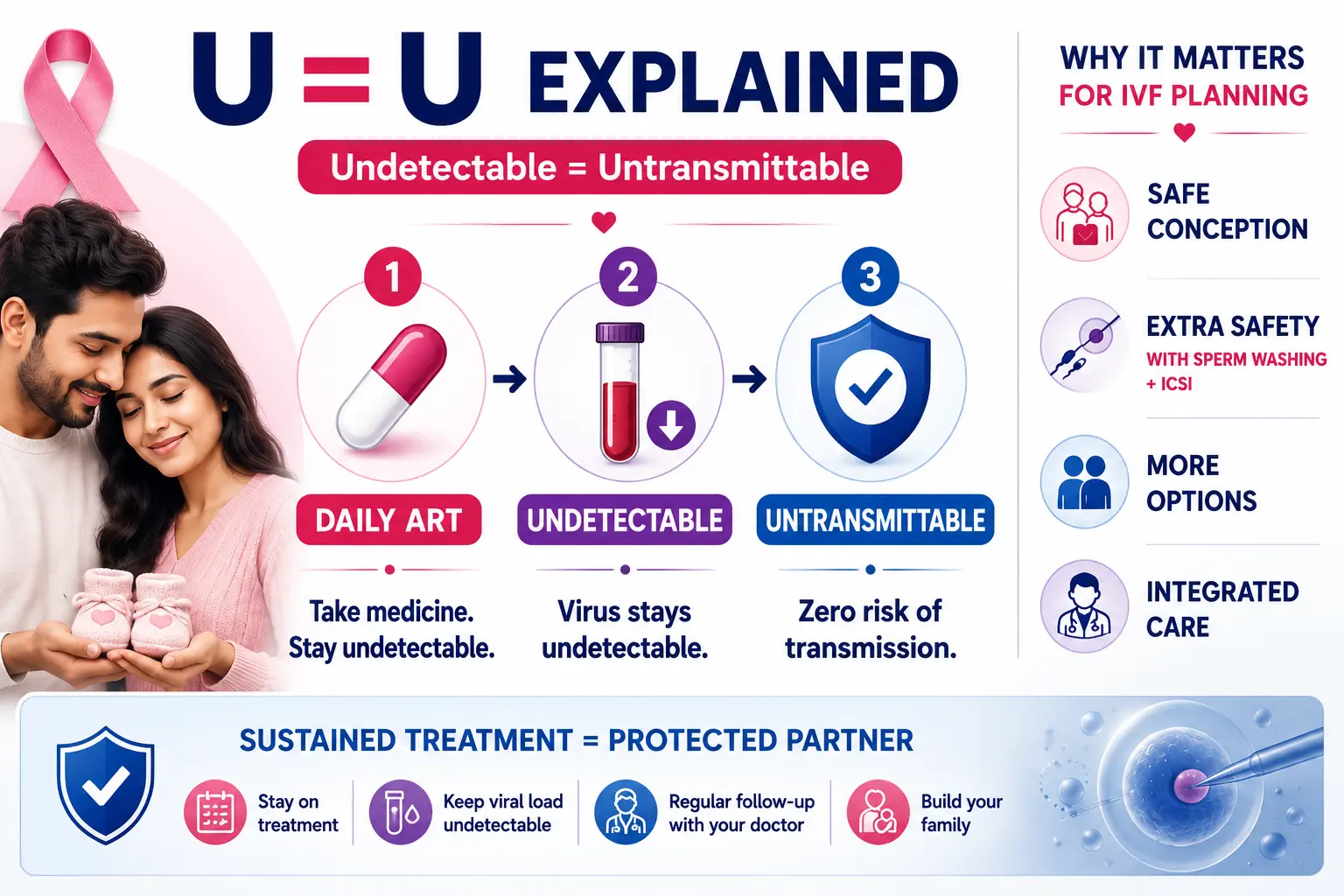
U=U stands for Undetectable equals Untransmittable. It is a scientific consensus, endorsed by over 1,000 health organisations across 100+ countries, confirming that a person living with HIV who takes ART daily and maintains a sustained undetectable viral load has effectively zero risk of sexually transmitting HIV to a partner.
This is not a hopeful theory. The PARTNER and PARTNER2 studies followed thousands of serodiscordant couples having condomless sex with the HIV positive partner virally suppressed, and recorded zero linked transmissions.
For couples planning IVF, U=U changes the safety picture in three important ways:
- It confirms that a virally suppressed HIV positive father poses no meaningful transmission risk during conception planning
- It supports the use of sperm washing plus ICSI as a highly conservative, near-zero-risk approach for those wanting maximum reassurance
- It informs newer options like timed intercourse with PrEP (pre-exposure prophylaxis) for the HIV negative partner, when medically appropriate
At Delhi IVF, our fertility team combines U=U principles with best-in-class sperm processing to give couples both scientific safety and practical peace of mind.
How Does Sperm Washing Work for HIV Positive Men?
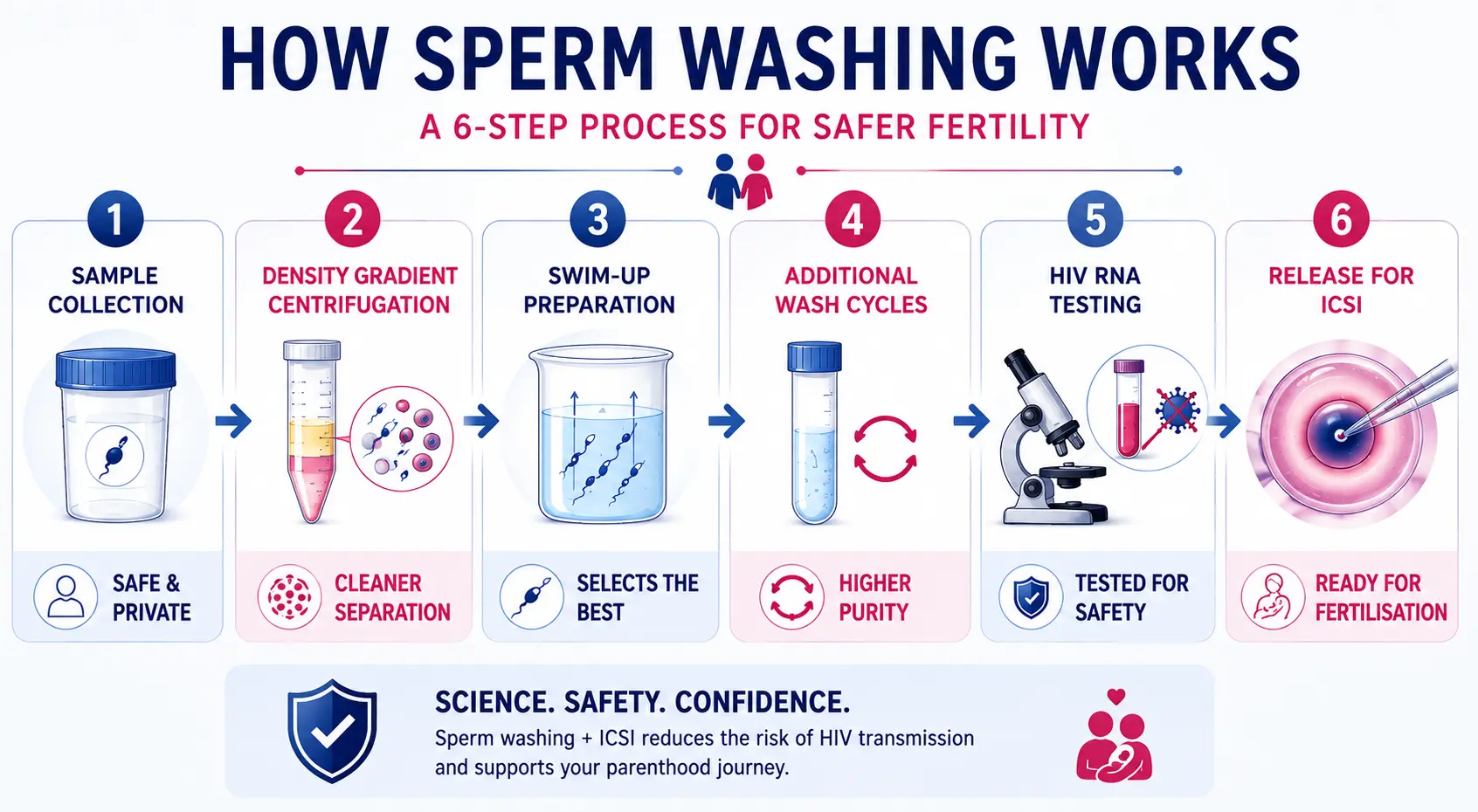
HIV lives in seminal fluid, not in sperm cells themselves. Sperm washing is the laboratory procedure that separates healthy motile sperm from the surrounding fluid and non-sperm cells that carry the virus. The processed sperm is then used with ICSI to fertilise the egg.
The Triple Sperm Wash Process (Step by Step)
- Semen sample collection in a sterile, private setting at the andrology laboratory
- Density gradient centrifugation to separate motile sperm from seminal plasma, immature cells and debris
- Swim-up preparation where the most active sperm are allowed to migrate into fresh culture media
- Additional wash cycles to further reduce residual viral particles
- HIV RNA testing of a portion of the washed sample using PCR technology
- Release for ICSI only if the washed sample tests HIV-negative
How Effective is Sperm Washing at Removing HIV?
Sperm washing reduces HIV in processed samples to undetectable levels in approximately 98% of cases. Combined with ICSI, where a single washed sperm is injected directly into the egg, the transmission risk becomes vanishingly small. Long-term global cohort data covering over 11,000 cycles have documented zero horizontal HIV transmissions to female partners and zero vertical transmissions to babies born through this protocol.
For HIV positive men, sperm washing plus ICSI at a specialised centre remains the gold standard for safe biological fatherhood.
What is the Step-by-Step IVF Process for HIV Positive Patients?
The core IVF cycle is similar to any patient, with additional testing and safety layers built in.
- Confidential consultation with the Delhi IVF fertility team, including a full review of your HIV history and current ART regimen
- Viral load and CD4 count assessment to confirm suppression readiness
- Complete fertility workup: hormonal profile, ovarian reserve testing, semen analysis, uterine evaluation
- Partner testing and PrEP counselling where applicable
- Sperm washing for male-positive cases in our andrology laboratory
- Ovarian stimulation with personalised medication protocols to produce multiple eggs
- Egg retrieval under light sedation, typically taking 20 to 30 minutes
- ICSI fertilisation using the washed HIV-negative sperm sample
- Embryo culture and grading over three to five days, with genetic screening available on request
- Embryo transfer into the uterus
- Luteal support and pregnancy test approximately 12 to 14 days later
- Specialised obstetric follow-up and coordinated delivery planning to prevent vertical transmission
What Are the Options When the Female Partner is HIV Positive?
When the woman is HIV positive, the treatment approach shifts from sperm processing to viral suppression, cycle monitoring and vertical transmission prevention.
Key protocol elements include:
- Continuing ART throughout stimulation, retrieval, transfer and pregnancy
- Viral load monitoring at each trimester
- Coordinated antenatal care with an infectious disease specialist
- Elective caesarean delivery in cases where viral load is not fully suppressed near term
- Formula feeding recommendations to eliminate breast milk transmission risk
- Newborn antiretroviral prophylaxis for the first 4 to 6 weeks after birth
With modern ART, the risk of mother-to-child HIV transmission has fallen from around 30% in the pre-treatment era to less than 1% today.
What is the Success Rate of IVF for HIV Positive Patients?
Success rates for HIV positive patients on well-controlled ART are broadly comparable to standard IVF outcomes when no additional fertility factors are present. Published cohort data show pregnancy rates per cycle largely in line with HIV negative populations of the same age group.
Delhi IVF's overall IVF success rate ranges between 50% and 80% depending on age, ovarian reserve, sperm parameters, and medical history. Well-suppressed viral load, healthy CD4 count, and integrated care with the HIV physician all support outcomes that meet the same benchmark.
How Much Does IVF Cost for HIV Positive Patients in India?
Fertility treatment costs for HIV positive patients include a standard IVF cycle plus specialised sperm processing and additional monitoring.
| Component | Estimated cost (INR) |
| Initial consultation and HIV workup | 5,000 to 12,000 |
| Complete IVF cycle with ICSI | 1,50,000 to 2,50,000 |
| Sperm washing (triple wash + viral testing) | 25,000 to 60,000 |
| Additional viral load and CD4 tests per cycle | 8,000 to 20,000 |
| Optional genetic screening (PGT) | 60,000 to 1,20,000 |
| Newborn HIV prophylaxis and testing | 5,000 to 15,000 |
At Delhi IVF, all costs are discussed openly during the first consultation. There are no hidden add-ons, and financial planning support is available for couples who want to phase treatment across cycles.
At Delhi IVF, all costs are discussed openly during the first consultation. There are no hidden add-ons, and financial planning support is available for couples who want to phase treatment across cycles.
Is There Any Risk of HIV Transmission to the Baby Through IVF?
The risk is extremely low when proper protocols are followed.
- For male HIV positive cases using sperm washing plus ICSI, no HIV transmissions to babies have been documented in the global data available
- For female HIV positive cases on suppressive ART, the mother-to-child transmission rate is under 1%, especially when combined with elective caesarean delivery (when indicated), formula feeding, and infant post-exposure prophylaxis
- For concordant positive couples, the same combined protocol applies with additional attention to newborn preventive treatment
Modern medicine has essentially removed HIV transmission from the IVF equation when patients are treated at a properly equipped centre.
What Legal Rights Do HIV Positive Patients Have for Fertility Treatment in India?
The ART (Regulation) Act 2021 explicitly prohibits discrimination in the provision of assisted reproductive services based on health status, including HIV. NACO's operational guidelines further affirm the right of people living with HIV to access reproductive healthcare, including IUI, IVF and ICSI.
If a fertility clinic refuses you treatment solely because of your HIV status, you have the right to:
- Request the reason for refusal in writing
- Seek a second opinion at an accredited ART centre
- File a complaint with the state health authority
- Report the incident to the National Human Rights Commission (NHRC)
Delhi IVF does not turn away patients based on HIV status. Your diagnosis is a clinical detail to be managed, not a barrier to parenthood.
Take Your First Step Toward Safe Parenthood
If you or your partner is HIV positive and want to start or grow your family, you deserve a fertility team that treats you with medical expertise, complete confidentiality, and genuine respect. Delhi IVF and Fertility Research Centre has helped couples from across India and 66+ countries navigate complex fertility journeys, including those affected by HIV.

