

When a couple first hears the word "IVF," the second thought is almost always about money. Not because they're shallow. But because they're practical. They're thinking about rent, about EMIs, about how far their savings will actually stretch. If you're researching the IVF cost in Delhi right now, that makes complete sense. Financial clarity isn't a distraction from the fertility journey. It is part of the journey.
This article breaks down exactly what IVF costs in Delhi. Stage by stage. No vague ranges. No fine print buried at the bottom. Delhi IVF has been helping couples build families since 1993. Over 33 years, one thing has stayed constant: people deserve honest answers before they make big decisions.
So let's get into it.
What is the Average Cost of One IVF Cycle in Delhi?
The cost of one IVF cycle in Delhi typically ranges from Rs. 1.2 lakhs to Rs. 2.5 lakhs for a base cycle. This range covers the core procedures. It does not automatically include medications, advanced techniques, or add-on tests. Those depend on your individual treatment plan and can affect the final number significantly.
Here's a useful way to think about it. The base IVF price is like a flight ticket. The seat gets you from point A to B. But check-in baggage, meals, and seat upgrades are separate. You only pay for what applies to your journey. IVF works the same way. The base cycle is the foundation. Everything built on top of it depends on your specific medical situation.
That's not a cop-out. That's just how fertility medicine works. No two patients are the same.
What Does the IVF Cost Include: A Stage-by-Stage Breakdown
Most IVF cost articles quote a number and stop there. That's not helpful. What you actually need to know is what happens at each stage and what it costs you. This is the breakdown that most clinics don't give you upfront.
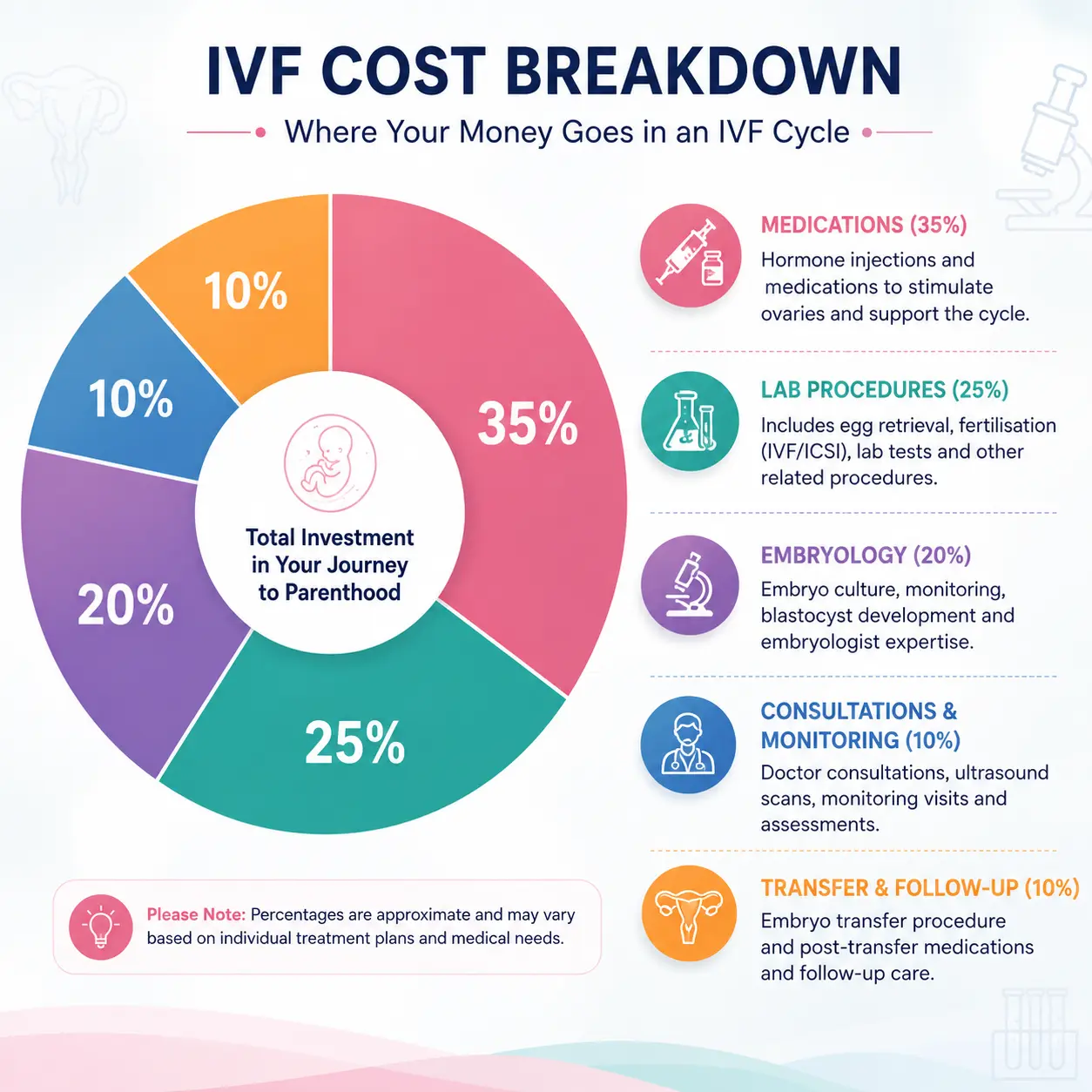
Initial Consultations and Diagnostic Tests
Before your IVF cycle begins, your doctor needs a complete picture of your fertility health. This phase is sometimes called the "workup." It includes a series of tests for both partners.
For the woman, this typically means:
- Hormonal blood tests like FSH, LH, AMH, and TSH
- A pelvic ultrasound to check the uterus and ovarian reserve
- A hysteroscopy or HSG scan if uterine issues are suspected
- Sometimes an ERA test, which checks whether the uterine lining is receptive to an embryo
For the man, it starts with a semen analysis. This test looks at sperm count, movement, and shape. Simple, but critical.
Think of this phase like a car inspection before a long road trip. You wouldn't drive from Delhi to Ladakh without checking the engine first. These tests tell your doctor what you're working with, what needs attention, and how to plan your cycle.
This diagnostic phase carries its own cost. It is separate from the IVF cycle cost itself. Factor it in from day one.
Ovarian Stimulation and IVF Injections
This is the phase that surprises most people. Not because of the needles. But because of what the medications cost.
During ovarian stimulation, you take hormone injections every day for roughly 8 to 12 days. The goal is to encourage your ovaries to produce multiple eggs in one cycle. Normally, your body releases one egg per month. IVF asks for more, because more eggs mean more chances.
The injection cost is one of the biggest variables in an IVF cycle. And it varies widely from patient to patient. Why? Because the dose depends on how your ovaries respond. Some women respond strongly to a low dose. Others need more medication over more days. Your age, your AMH level, and your diagnosis all play a role.
At Delhi IVF, protocols are built around the individual patient. The aim is always to get the right response. Not the maximum response. Over-stimulation, called OHSS, is a real medical risk. A good doctor calibrates your medication. A less careful clinic just increases the dose and hopes for the best.
Personalised stimulation protects your health and avoids unnecessary medication costs.
Egg Retrieval and Fertilisation (ICSI if Required)
Once the follicles are mature, the eggs are retrieved. This is a minor procedure done under sedation. A thin needle, guided by ultrasound, collects the eggs from the ovaries. It takes about 20 to 30 minutes. Most women feel back to normal within a day.
After retrieval, the eggs are taken to the embryology lab. This is where fertilisation happens.
In a standard IVF cycle, sperm and eggs are placed together in a dish. Fertilisation happens naturally. But sometimes, the sperm need a little help getting in. That's where ICSI comes in.
ICSI stands for Intracytoplasmic Sperm Injection. A single sperm is selected and injected directly into each egg. It's used when:
- Sperm count or motility is low
- Previous IVF cycles had poor fertilisation
- The sperm was surgically retrieved
- Fertilisation failed in a previous attempt
ICSI adds to the base IVF cost. But in the right cases, it significantly improves fertilisation rates. It's not an upsell. It's a medical decision. If your doctor recommends it, there's a clinical reason behind it.
Embryo Culture and Transfer
After fertilisation, the embryos are kept in the lab for 3 to 5 days. During this time, the embryologists watch them closely. They're looking for embryos that develop well and reach what's called the blastocyst stage.
A blastocyst is a more advanced embryo. It's reached day 5 or 6 of development. It has a higher chance of implanting successfully. Think of it like waiting for fruit to ripen fully before picking it. A blastocyst is ready. An early-stage embryo might still need time.
Blastocyst culture requires advanced lab conditions and more days of monitoring. It comes at a slightly higher cost. But it often improves success rates, especially in patients with multiple embryos to choose from.
The embryo transfer itself is a simple procedure. No sedation needed in most cases. A thin catheter is placed into the uterus to place the embryo. It's done in a few minutes and feels similar to a routine pelvic exam.
Lab costs, embryologist time, and the transfer procedure are all part of this phase.
Frozen Embryo Transfer (FET): If Applicable
Sometimes, not all embryos from a cycle are transferred immediately. This can happen for several reasons:
- The uterus isn't ready after stimulation
- The doctor recommends a "freeze-all" approach for better outcomes
- Extra embryos remain after the fresh transfer
- A fresh transfer didn't result in pregnancy, and the couple has frozen embryos waiting
In these situations, embryos are frozen and stored through a process called cryopreservation. A Frozen Embryo Transfer, or FET, is then done in a later cycle.
FET is generally less physically demanding than a full fresh cycle. You skip the stimulation and retrieval phase. The cost is lower as a result. But it is still a separate procedure with its own pricing.
If your doctor recommends a freeze-all strategy from the start, factor FET into your overall budget.
Medications After Transfer
This one gets overlooked almost every time.
After the embryo is transferred, your body needs hormonal support to maintain the uterine lining. This usually means progesterone supplements, sometimes estrogen as well. These are taken daily, sometimes for several weeks, until a pregnancy test confirms the outcome.
These medications are not expensive relative to the rest of the cycle. But they are a real cost. And they are often not included in advertised package prices.
When you get a quote from any clinic, ask specifically: Are post-transfer medications included?
What Additional Costs Should You Be Aware Of?
This is the section most clinics skip. We're not going to.
PGT or PGD testing is recommended in certain cases. If there's a genetic condition in the family, a history of recurrent miscarriages, or the patient is older, genetic testing of the embryos before transfer may be advised. This is called Preimplantation Genetic Testing. It's an advanced add-on with its own significant cost.
Donor egg IVF is a different programme entirely. If your own eggs can't be used due to age, diminished ovarian reserve, or early menopause, donor eggs are the path forward. The cost structure for donor egg IVF is different from a standard cycle.
Donor sperm carries its own fee if required due to severe male factor infertility or other reasons.
Cryopreservation and annual storage fees apply when embryos, eggs, or sperm are frozen and kept for future use.
Repeat cycles are a financial reality that many couples face. IVF success on the first attempt is not guaranteed. Planning for the possibility of a second cycle is not pessimistic. It is sensible.
None of these are surprise trap. They are simply the parts of a fertility journey that look different for every person. Knowing they exist before you begin is far better than discovering them mid-treatment.
Factors That Affect IVF Cost in Delhi
Here is why two people sitting in the same waiting room at the same clinic can end up with very different bills.
Age is one of the biggest factors. Women above 35 often have a lower ovarian reserve. This can mean higher medication doses, more monitoring appointments, and a greater likelihood of needing additional procedures or cycles.
Diagnosis shapes the entire treatment plan. The cause of infertility, whether it's male factor, female factor, or unexplained, changes what procedures are needed and, therefore, what the total cost looks like.
Response to stimulation is unpredictable. Some women produce 10 to 15 eggs on a low dose. Others produce 3 or 4 on a high dose. That difference directly affects medication costs and the number of viable embryos available.
Add-on procedures like ICSI, ERA testing, blastocyst culture, and PGT each add to the base price when they are medically indicated.
The number of cycles is perhaps the most significant factor of all. One cycle might work. Two or three might be needed. That's not a flaw in the process. It's the honest reality of fertility treatment.
Donor involvement changes the cost structure entirely.
This is why a website quote is never the full picture. A personalised consultation is the only way to get a number that actually applies to you.
IVF Cost vs IVF Success Rate: How to Think About Value
Here's a comparison worth sitting with.
Clinic A charges Rs. 1 lakh per cycle. Their success rate for your age group is 20%. Clinic B charges Rs. 1.8 lakhs per cycle. Their success rate for your age group is 55%.
Over three attempts, Clinic A costs Rs. 3 lakhs and may still not have worked. Clinic B costs Rs. 1.8 lakhs and has a good chance of succeeding in one. Which clinic is actually more affordable?
This is not an argument to ignore price. Price absolutely matters. But it's an argument to look at the full picture, not just the headline number.
Delhi IVF has helped over 25,000 couples welcome a baby since 1993. That number didn't happen by accident. It happened because of experienced embryologists, precise protocols, and a commitment to treating each patient as an individual rather than a case number.
When you evaluate IVF cost in Delhi, ask every clinic two questions. What is your success rate? And what is your success rate specifically for someone with my diagnosis and my age? A lower price at a clinic with significantly lower success rates often means more cycles, more cost, and more heartbreak in the long run.
Why Personalised IVF Plans Matter More Than Standard Packages
You'll see clinics advertising IVF "packages." A flat price. A fixed list of inclusions. It looks simple and reassuring.
But here's the truth.
A 28-year-old woman with unexplained infertility and a 42-year-old woman with diminished ovarian reserve should not be on the same protocol. Their bodies are different. Their medication needs are different. Their risks are different. Their chance of needing advanced procedures is different.
Packages work beautifully for hotel rooms. For fertility treatment, they can lead to under-treatment in one patient and unnecessary procedures in another.
At Delhi IVF, every treatment plan is built from scratch. It starts with your test results, your diagnosis, and your specific goals. You'll know what each component of your plan costs and why it's included. No surprises. No add-ons you weren't told about.
That is what 33 years of experience looks like in practice.
Conclusion
IVF is a significant financial commitment. It would be dishonest to pretend otherwise. But it is also one of the most guided, evidence-based paths to parenthood available today.
The best thing you can do right now is replace uncertainty with a real conversation. A consultation won't just tell you what your treatment might cost. It will tell you what your options are, what your chances look like, and what a realistic plan would involve. At Delhi IVF, that conversation comes with 33 years of experience, complete transparency, and no pressure.
Clarity is the first step. Speak to a Delhi IVF specialist today and understand exactly what your treatment journey will look like.

