

The short answer is no. In IVF, you cannot choose your baby's gender in India. The PC-PNDT Act, 1994 bans sex selection before and after conception, and that includes picking embryos by sex after preimplantation genetic testing (PGT). The law applies to doctors, laboratories and the patients who ask, whatever passport they hold.
If you are in Canada and thinking about IVF in India for Canadian couples, there's a second part to the answer. Canada bans non-medical sex selection too, so travelling here doesn't open a door that's closed at home. What India can offer, legally, is genetic testing that helps you transfer a healthy embryo and avoid passing on an inherited disease.
We hear this question a lot, and we never treat it as a strange one to ask. Sometimes it comes from a family with two daughters and grandparents hoping for a boy. Sometimes it comes from a mother who has watched a genetic illness pass down the men in her family. The legal answer is the same in both cases, but the options are very different, and that's what this article walks through.
Key Facts at a Glance
| Question | Answer |
| Is gender selection through IVF legal in India? | No, under the PC-PNDT Act, 1994 (amended 2003) |
| Does the ban cover embryo testing (PGT)? | Yes. Embryos cannot be chosen by sex, and the sex cannot be disclosed |
| Who can be prosecuted? | Doctors, clinics, labs, and the person who asks for sex selection |
| Does it apply to foreigners and NRIs? | Yes. Nationality makes no difference |
| Is gender selection legal in Canada? | No, except to prevent a sex-linked disease (Assisted Human Reproduction Act, 2004) |
| What can PGT legally do in India? | Screen embryos for chromosomal problems and known inherited diseases |
The PC-PNDT Act is India's law against sex selection. Its full name is the Pre-Conception and Pre-Natal Diagnostic Techniques (Prohibition of Sex Selection) Act, 1994, and it covers every registered clinic, genetic laboratory, and doctor in the country. It was brought in to stop medical technology being misused to choose a child's sex, and it is enforced seriously.
Which sections of the Act matter to IVF patients?
Four provisions do most of the work:
- Section 3A makes it illegal for anyone to carry out, or help with, sex selection on a woman, a man, or on any embryo, tissue or gamete taken from them.
- Section 5(2) stops anyone from telling a pregnant woman, her family or anyone else the sex of the foetus, whether in words, by signs or any other way.
- Section 22 bans advertising sex selection or sex determination in any form, including online.
- Section 27 makes every offence under the Act cognizable, non-bailable and non-compoundable. In plain terms, police can act without a warrant, bail isn't automatic, and the case can't simply be settled privately.
Why did the 2003 amendment bring IVF under the ban?
When the law was first passed in 1994, it focused on finding out the sex of a baby during pregnancy, mainly by ultrasound. By the early 2000s, laboratory techniques could influence a child's sex before pregnancy even began. So in 2003 the law was amended to cover pre-conception techniques, and "Prohibition of Sex Selection" was added to its name.
The amendment also widened the meaning of sex selection to include any procedure that makes a particular sex more likely. That's the part that covers an IVF lab. Choosing a male or female embryo for transfer counts, even if no one ever performs a scan.
What are the penalties for gender selection in India?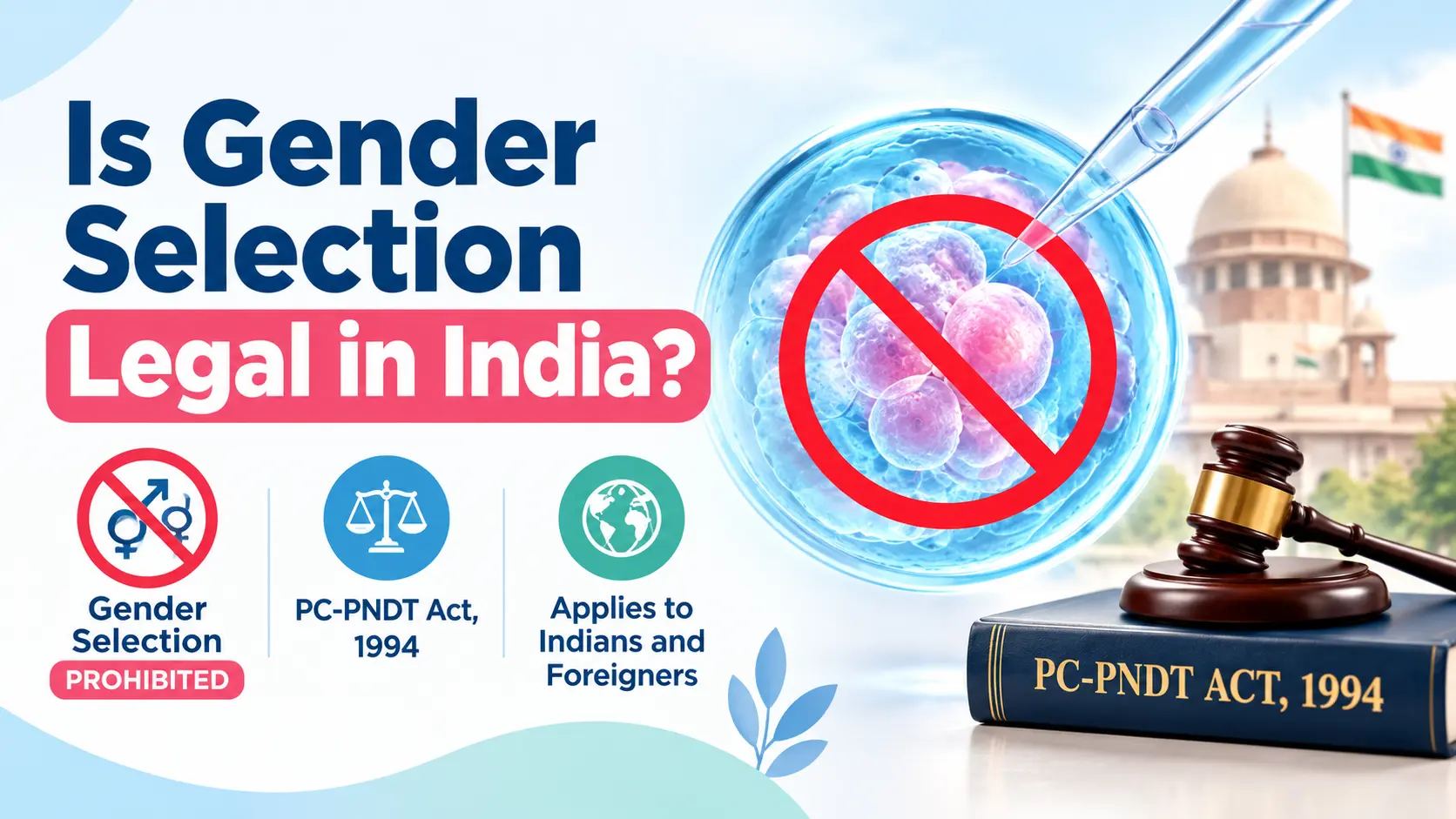
The penalties sit in Section 23, and they apply to both sides of the conversation, not just the doctor.
| Who | First offence | Repeat offence |
| Doctor, clinic or laboratory | Up to 3 years in prison and a fine up to ₹10,000 | Up to 5 years in prison and a fine up to ₹50,000 |
| Person seeking sex selection (including a husband or relative) | Up to 3 years in prison and a fine up to ₹50,000 | Up to 5 years in prison and a fine up to ₹1,00,000 |
Doctors face a further penalty. The State Medical Council can suspend a doctor's registration while the case is heard, then remove their name from the medical register for five years on a first conviction, and permanently on a second. The Act also protects a pregnant woman who was compelled to undergo sex selection: she is not punished under these provisions.
Does the ART Act 2021 also ban gender selection?
Yes. The Assisted Reproductive Technology (Regulation) Act, 2021 governs every IVF clinic and ART bank in India. It allows preimplantation genetic testing only to screen for known, pre-existing, heritable or genetic diseases, and it separately bars clinics from offering a child of a predetermined sex. Section 25 of the Act covers preimplantation genetic testing, Section 26 prohibits sex selection, and Section 32 sets out the punishment for offering sex-selective assisted reproduction.
So a clinic in India that offered gender selection wouldn't be bending one rule. It would be breaking two separate laws.
Can PGT Tell You the Sex of an Embryo?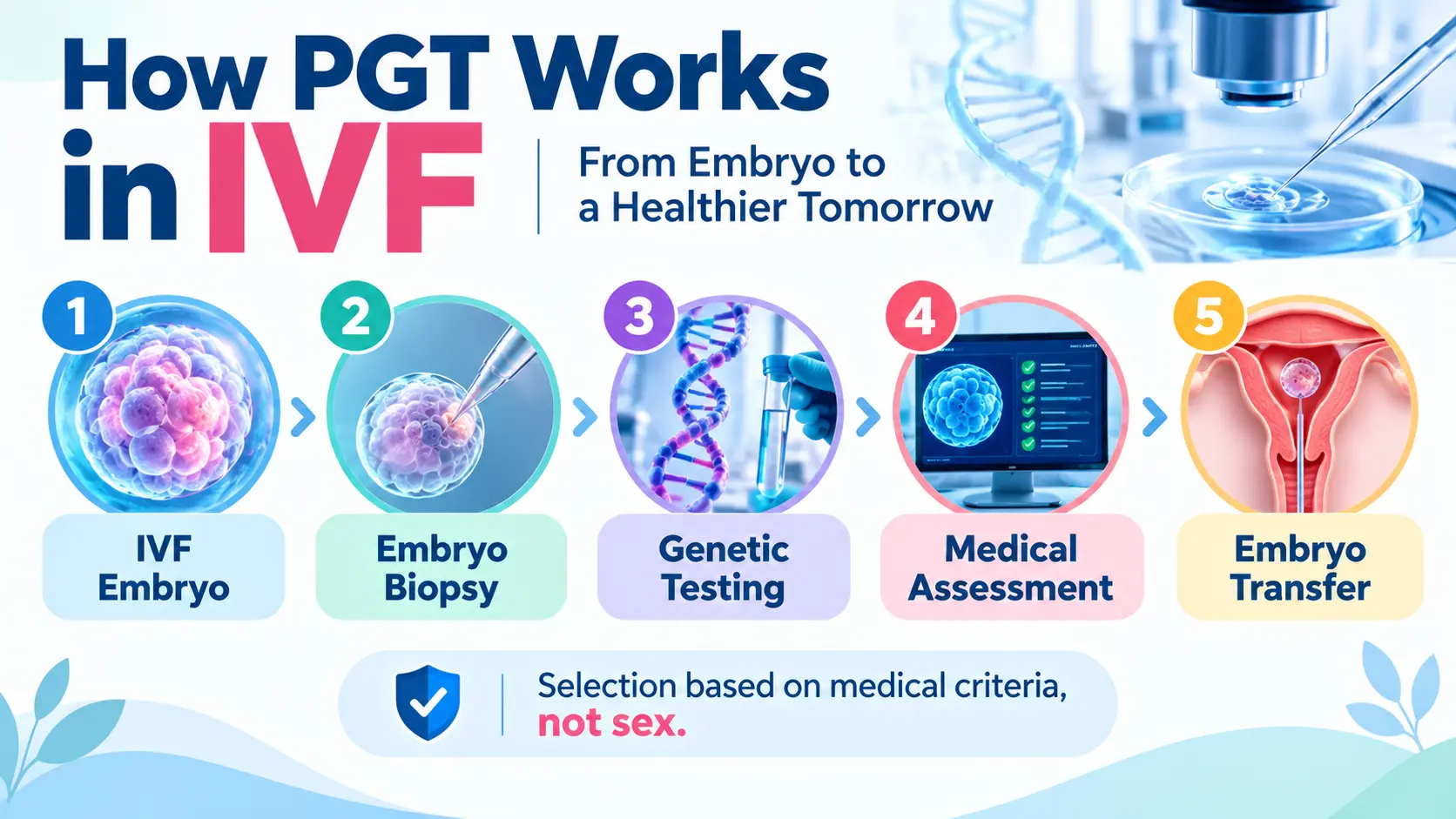
Technically, yes, but in India the clinic is not allowed to use or share that information.
Every embryo carries either XX or XY sex chromosomes, and a full chromosomal screen can read them. That's exactly why the law steps in. Just because something can be done in a lab doesn't mean it's permitted.
In India, PGT is allowed for medical reasons only. A clinic working within the law will:
- use PGT to check for chromosomal abnormalities (PGT-A), single-gene disorders (PGT-M) or structural rearrangements (PGT-SR);
- choose which embryo to transfer on medical grounds alone;
- never tell you the sex of an embryo, either in conversation or in a written report.
At Delhi IVF, embryo biopsy and selection are handled by the embryology team led by our Chief Embryologist, Mrs. Alka Gupta. The decision about which embryo to transfer rests on its chromosomal health and how well it has developed. Sex doesn't come into it, and it's never discussed with you.
Is Gender Selection Legal in Canada?
No, not for non-medical reasons. Canada's Assisted Human Reproduction Act, 2004 treats sex selection as a prohibited activity, and breaking that rule is a criminal offence.
Under Section 5(1)(e), it's illegal, when creating a human being, to do anything that would ensure or increase the chance of an embryo being a particular sex, or that would identify the sex of an embryo created in a lab. The only exception is to prevent, diagnose or treat a sex-linked disorder or disease.
Health Canada gives a very familiar example of what the ban is aimed at: parents who want a child of a particular sex to "balance" their family. For Canadian couples, then, the answer is the same at both ends of the journey.
How do the Indian and Canadian rules compare?
| Question | India | Canada |
| Main law | PC-PNDT Act, 1994 (amended 2003); ART (Regulation) Act, 2021 | Assisted Human Reproduction Act, 2004 |
| Choosing a sex for family balancing | Prohibited | Prohibited |
| Can the clinic tell you an embryo's sex? | No | No, except under the sex-linked disease exception |
| Who can be penalised? | Doctors, clinics, labs and the person seeking it | Anyone who performs or provides it |
| PGT to screen for genetic disease | Permitted | Permitted |
Can You Choose Gender for Medical Reasons, Such as a Sex-Linked Disease?
Not by choosing a sex, but India does offer a lawful way to protect your child from a sex-linked disease. Here, the two countries word their laws differently.
Some serious conditions, such as haemophilia and Duchenne muscular dystrophy, are X-linked. They mostly affect boys, and a mother can carry the gene without being ill herself. Canada's law explicitly allows sex selection to prevent a disorder like this.
India takes a different path. The PC-PNDT Act allows diagnostic techniques to be used to detect sex-linked genetic diseases, and the lawful way to do that in IVF is PGT-M. Instead of looking at whether an embryo is male or female, PGT-M tests each embryo for the specific gene mutation in your family.
Medically, that's actually the better approach. Choosing by sex alone would throw away healthy embryos of the affected sex and could still transfer a daughter who carries the gene. Testing for the mutation itself means the team can transfer an embryo that's unaffected, and the embryo's sex is never part of the decision or shared with you.
If you carry an X-linked condition, bring your genetic reports to your first consultation. A custom PGT-M test usually takes a few weeks to design, so it helps to start before your IVF cycle is booked.
What Can Genetic Screening Legally Do for You in India?
Quite a lot, as long as the reason is medical. For most couples, the more useful question isn't "boy or girl?" but "which embryo gives us the best chance of a healthy baby?" That's the question genetic screening for IVF is built to answer.
- PGT-A checks embryos for the wrong number of chromosomes. This is one of the most common reasons embryos fail to implant or a pregnancy ends in early miscarriage. It's usually recommended for women over 35, couples with repeated IVF failure, and couples who have had more than one miscarriage.
- PGT-M tests for a single-gene condition that runs in your family, such as thalassaemia, sickle cell disease or cystic fibrosis.
- PGT-SR helps when one partner carries a balanced translocation or another structural change in their chromosomes.
At Delhi IVF, PGT-A typically costs ₹50,000 to ₹1,20,000* for up to eight embryos, and PGT-M costs ₹80,000 to ₹2,00,000* depending on the condition. Both are added to the cost of the IVF cycle itself, which is usually ₹1.5 to ₹2.5 lakh*.
- Costs are indicative. Your final cost depends on your medical assessment, and additional tests, medicines or treatments may be needed. It is confirmed in your written estimate.
Screening isn't something every couple needs. For a younger woman on her first cycle with no history of miscarriage or genetic illness, it often adds cost without adding much benefit. Your specialist will tell you honestly whether it's likely to help in your case.
Does the Gender Selection Ban Apply to NRIs, OCI Cardholders and Foreigners?
Yes, completely. The PC-PNDT Act covers everything done in India, regardless of nationality, residence or passport. A Canadian citizen, an OCI cardholder and a couple who live in Delhi are all bound by exactly the same rule. There's no tourist, medical visa or NRI exception.
The same thinking runs through the wider rules for foreign patients under the ART Act, which set out who can access treatment in India, how donor eggs and sperm are handled and what clinics must record. Couples of Indian origin living in Canada do have some distinct IVF options for OCI cardholders and NRIs, particularly around surrogacy, but sex selection isn't one of them.
How Can You Tell an IVF Clinic in India Is Following the Law?
A trustworthy clinic will be open about this from your very first call. These are the signs to look for:
- A PC-PNDT notice on display. Registered centres must show, in plain view, that sex selection is illegal and not carried out.
- A clear "no" when you ask. If a clinic, agent, or website hints at gender selection, "family balancing" packages or a quiet workaround, they're breaking Indian law, and you could be held liable too.
- A medical reason for PGT. Genetic testing should be recommended because of something in your history, not sold to everyone as an add-on.
- ART Act registration. Ask for the clinic's registration details. A genuine clinic won't hesitate.
- Named specialists. You should know which doctor and which embryologist are responsible for your treatment.
Delhi IVF opened in 1993, delivered Delhi's first ICSI baby in 1996, and has since helped more than 25,000 babies into the world. Every one of those families was treated within the law, and that isn't going to change.
If Gender Selection Isn't Allowed, Why Do Canadian Couples Still Choose IVF in India?
Mostly because of cost and waiting times. With gender selection off the table in both countries, the reasons Canadian couples travel are practical ones.
The Ontario Fertility Program funds one IVF cycle for women under 43, but it doesn't cover fertility medicines, which the province puts at around CAD 5,000 a cycle, or genetic testing and embryo storage. Wait lists at funded clinics have been reported at six to 18 months, sometimes longer. Privately, a single cycle in Canada costs roughly CAD 10,000 to 20,000 before medicines. In India, an IVF cycle typically costs ₹1.5 to ₹2.5 lakh*, and once your tests are done, there's no waiting list to join.
Plan for three to six weeks in Delhi for a full cycle with a fresh embryo transfer, depending on your medical condition, or about two weeks if your embryos are frozen for a later transfer. If his test results are normal, your husband may need only three to four working days, though he's welcome to stay throughout. Delhi IVF also has in-house accommodation options set aside for international patients. They're economical, and you can ask our team for photos and prices before you book anything.
You don't need to book a flight to get started. Dr. Anoop Gupta and Dr. Aastha Gupta offer video consultations, so you can go through your reports together, find out whether genetic screening is relevant to you, and plan your time in Delhi before you travel. Many patients from Canada and the UK finish their pre-IVF tests at home and arrive ready to begin.
Planning IVF in India From Canada?
So, in IVF, can we choose gender in India? No, and any honest clinic will tell you the same. What we can give you is a clear medical plan, genetic testing where it genuinely helps, and a team that has been doing this work for more than three decades.

