

You walked into a fertility clinic hoping to plan your family. You disclosed your HIV, Hepatitis B, or Hepatitis C status honestly. And then you were told the clinic "does not treat such cases", or asked to look elsewhere, or given a vague medical excuse that felt like a polite door being closed.
You are not imagining it. This happens across India every day, and thousands of couples quietly walk away believing they have no choice. Here is what most patients are never told: refusing you fertility care solely because you are HIV positive is illegal under Indian law. Refusing you because you are hepatitis positive violates constitutional protections and medical ethics regulations. You have specific legal rights, specific complaint pathways, and specific clinics like Delhi IVF and Fertility Research Centre that welcome you and treat you with the same expertise as any other patient.
This blog, reviewed by Dr. Anoop Gupta, explains exactly what Indian law says, what you can do if a clinic refuses you, where you can file a complaint, and how modern reproductive medicine has made IVF for HIV and hepatitis positive patients safe, standard practice.
Is It Legal for a Fertility Clinic to Refuse Treatment Based on HIV or Hepatitis Status?
No. Denial of fertility treatment solely based on HIV status is a criminal offence under Indian law. Denial based on hepatitis status violates constitutional protections and medical ethics rules.
The legal framework rests on four pillars:
- HIV and AIDS (Prevention and Control) Act, 2017 - specifically prohibits discrimination in healthcare services against HIV positive people
- ART (Regulation) Act, 2021 - imposes duty of care standards on all registered fertility clinics
- Constitution of India, Articles 14 and 21 - guarantee equality and the right to health for every citizen
- National Medical Commission (NMC) ethics regulations - require doctors to provide care without discrimination
For HIV positive patients, protection is explicit and criminal in nature. For Hepatitis B and Hepatitis C patients, protection is grounded in constitutional and ethical standards, and any refusal is medically unjustifiable given modern universal precautions and standard laboratory biosafety practices.
What Does the HIV and AIDS (Prevention and Control) Act 2017 Say?
The HIV Act 2017 is India's landmark anti-discrimination law for people living with HIV. It came into force on 10 September 2018 and made India the first country in South Asia to statutorily prohibit HIV discrimination.
The most important provision for fertility patients is Section 3, which prohibits discrimination against a "protected person" (any HIV positive individual, or anyone living with an HIV positive person) in relation to:
- Employment or occupation
- Healthcare services (including fertility treatment)
- Educational establishments
- Residing, renting or occupying property
- Standing for public or private office
- Access to insurance
- Freedom of movement
The Act also prohibits requiring HIV testing as a prerequisite for accessing healthcare. Section 4 criminalises hate speech and propagation of discrimination against HIV positive people.
In 2024, the Supreme Court of India issued directions to Central and State governments to ensure effective implementation of the HIV Act, and directed all courts, tribunals and quasi-judicial bodies to prioritise HIV-related cases for early disposal. This gives your complaint real teeth if a fertility clinic refuses you.
Delhi IVF, which has treated HIV positive couples as part of routine practice for many years, works fully within this framework, coordinating your fertility treatment with your treating HIV physician.
What Are Your Rights Under the ART (Regulation) Act 2021?
The ART Act 2021 regulates fertility clinics and ART banks across India. All fertility clinics must be registered with the National ART and Surrogacy Board. The Act imposes several duties directly relevant to HIV and hepatitis positive patients:
- Duty of care: clinics must provide services in line with prescribed standards and cannot arbitrarily refuse treatment
- Informed consent: you have the right to a full explanation of risks, options and alternatives before any procedure
- Confidentiality: clinics are legally obligated to protect your medical information, including your HIV or hepatitis status
- Ethical practice: commercialisation of gametes, embryos and misleading practices are prohibited
- Complaint mechanism: patients can report violations to the State ART Board in each state
If a registered fertility clinic refuses you treatment without a documented, medically valid reason, this constitutes a violation of the Act's duty of care standard and can be reported to the State ART Board for investigation.
What About Hepatitis B and Hepatitis C Patients? Are They Also Protected?
Yes, though the protection is structured differently. India does not have a hepatitis-specific anti-discrimination statute, but hepatitis positive patients are protected under:
- Article 14 of the Constitution: guarantees equality before the law and equal protection
- Article 21 of the Constitution: guarantees the right to life, which the Supreme Court has repeatedly interpreted to include the right to healthcare
- NMC ethics regulations: require doctors to treat patients without discrimination based on health status
- ART Act 2021: applies equally to hepatitis positive patients as duty of care standards
- Consumer Protection Act 2019: medical negligence and unfair trade practices can be challenged in consumer forums
There is no medical justification for refusing hepatitis positive patients fertility care. With standard universal precautions in the laboratory, tenofovir antiviral therapy where indicated, direct-acting antivirals now curing Hepatitis C in 8 to 12 weeks, and newborn HBIg plus birth-dose vaccination for Hepatitis B, safe treatment is entirely possible. This is fully covered in the IVF for HIV, Hepatitis B, and Hepatitis C positive patients framework used at Delhi IVF.
What Should You Do If a Fertility Clinic Refuses You?
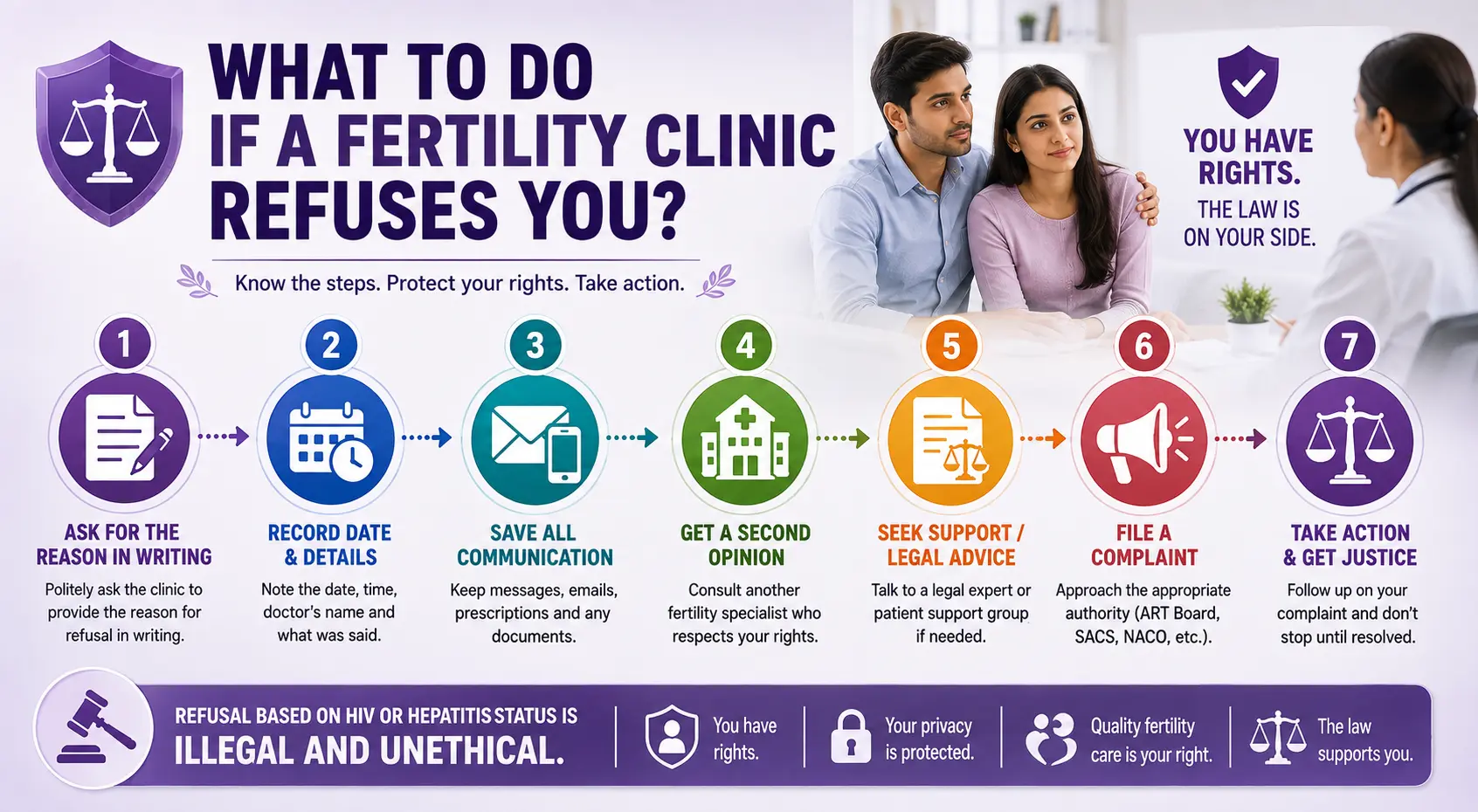
If you have been refused, take these steps calmly and in order. Documentation is your strongest asset.
- Ask for the reason in writing. Request a signed letter or an email stating the medical grounds for refusal. Most clinics that discriminate will refuse to put it in writing, which itself becomes evidence.
- Note the date, time, staff involved, and location of the interaction while it is fresh in memory.
- Keep every written communication, including WhatsApp messages, emails, appointment confirmations, and referral notes.
- Do not lose your composure at the clinic. Anger, even justified, weakens your position later. Stay factual.
- Seek a second opinion at an accredited centre that treats HIV and hepatitis positive patients openly, such as Delhi IVF. Getting the right treatment is your priority.
- Consult a lawyer or an HIV rights organisation if you decide to escalate. Groups like the Lawyers Collective and Positive Women Network offer support.
- File a formal complaint with the appropriate authority (see the next section).
Your goal is two-fold: get the fertility care you need and hold the discriminating clinic accountable so the next patient does not face the same door.
Where and How Do You File a Complaint?
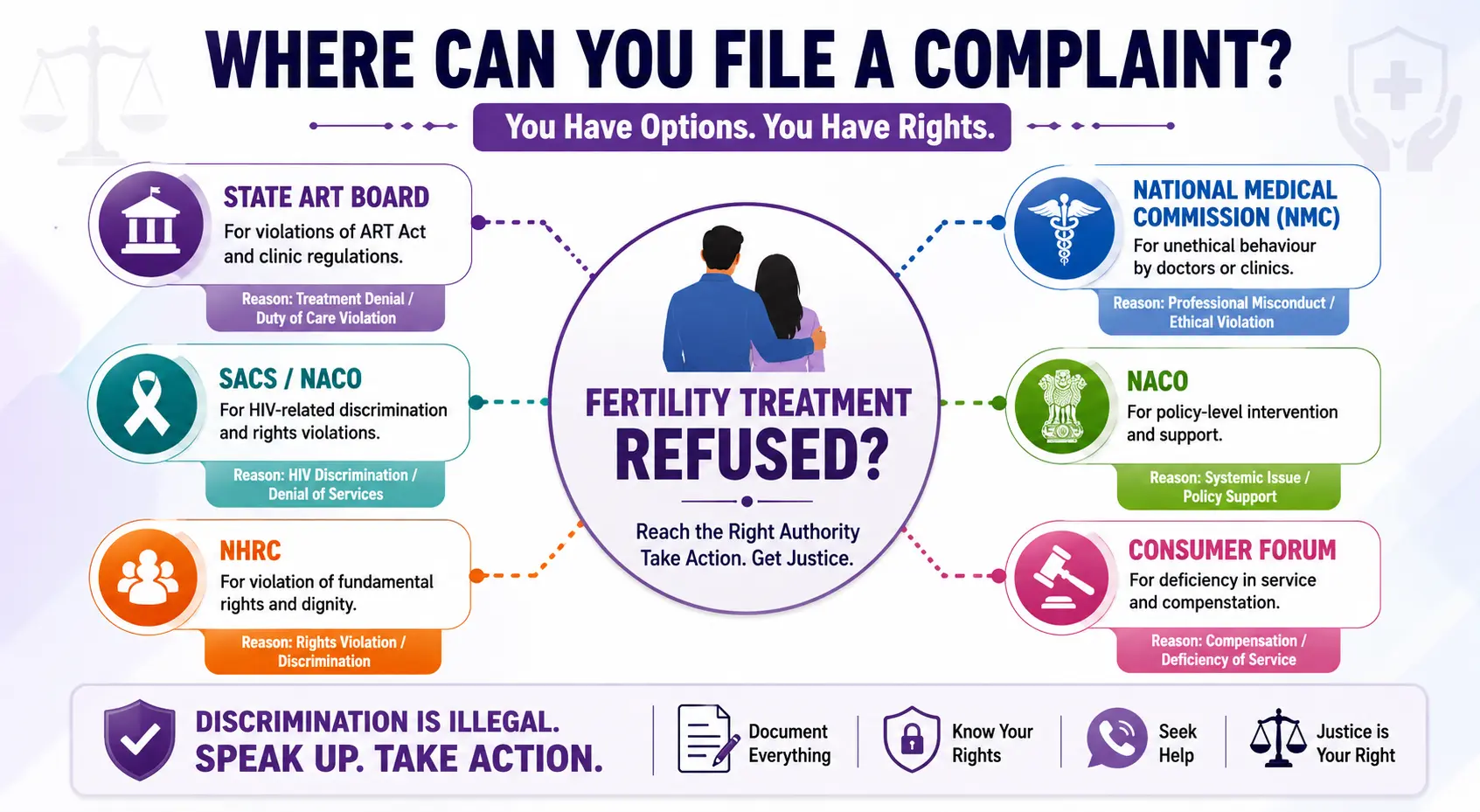
You have multiple parallel routes. Filing with more than one is allowed and often recommended.
| Authority | What it handles | How to approach |
| State ART Board | ART Act violations, duty-of-care breaches | State health department portal or written complaint |
| State AIDS Control Society (SACS) | HIV Act violations in healthcare | Contact through NACO website |
| National AIDS Control Organisation (NACO) | Systemic HIV discrimination issues | naco.mohfw.gov.in |
| National Human Rights Commission (NHRC) | Fundamental rights violations | nhrc.nic.in |
| State Human Rights Commission | Rights violations at state level | State-specific portal |
| Consumer Disputes Redressal Commission | Medical negligence, unfair trade practice | District, State or National Consumer Forum |
| National Medical Commission (NMC) | Medical ethics violations by doctors | nmc.org.in |
| State Medical Council | Doctor conduct at state level | State council portal |
For HIV-specific complaints, the SACS route combined with an NHRC complaint has historically produced the fastest response. For ART Act duty-of-care violations, the State ART Board is the primary body.
What Are the Penalties for Clinics That Discriminate?
Penalties exist under multiple statutes:
- HIV Act 2017: discrimination against HIV positive persons in healthcare can attract imprisonment up to two years and a fine of up to Rs 1,00,000, along with civil damages
- ART Act 2021: violations of duty of care, ethical standards, and confidentiality obligations can lead to significant fines, cancellation of registration, and, in serious cases, criminal prosecution
- Consumer Protection Act 2019: monetary compensation for medical negligence and deficiency of service
- NMC regulations: professional misconduct proceedings can result in suspension or cancellation of a doctor's medical licence
These are not theoretical. The Supreme Court's 2024 direction to prioritise HIV Act cases has made enforcement significantly more active than it was even three years ago.
Why Some Clinics Still Refuse - And What Delhi IVF Does Differently
Fertility clinics that refuse HIV or hepatitis positive patients usually offer one of three excuses: they "do not have the facilities", they claim the "risk to other patients" is too high, or they cite unspecified "medical reasons". None of these hold up medically:
- Standard universal precautions in every accredited fertility laboratory protect other patients' samples from cross-contamination
- Advanced sperm processing techniques, including sperm washing, eliminate viral particles from processed samples
- Modern antiretroviral therapy for HIV, tenofovir for high-viral-load Hepatitis B, and direct-acting antivirals that cure Hepatitis C have transformed what is medically possible
At Delhi IVF and Fertility Research Centre, HIV and hepatitis positive patients have been treated as part of routine practice for many years, with the same clinical rigour and confidentiality as any other patient. Under the direction of Dr. Aastha Gupta, fertility treatment is coordinated with your existing HIV physician or hepatologist so care is integrated, not fragmented.
Book Your Confidential Consultation
If you have been refused fertility treatment because of your HIV, Hepatitis B, or Hepatitis C status, you do not have to accept "no" as the final word. Indian law is on your side. Modern medicine is on your side. And clinics like Delhi IVF and Fertility Research Centre are on your side.

