
Being told you cannot become a parent because of HIV, Hepatitis B or Hepatitis C is one of the most painful experiences a couple can face. Many fertility clinics in India still turn away positive patients out of fear, stigma, or unfamiliarity with the protocols. The truth is that modern reproductive medicine has changed this picture entirely. Couples with HIV, Hepatitis B and Hepatitis C can now safely undergo IVF and welcome healthy, virus-free babies.
At Delhi IVF and Fertility Research Centre, we have supported patients from 66+ countries through complex fertility journeys since 1993, including couples affected by chronic viral infections. Under the direction of Dr. Anoop Gupta, our team combines advanced sperm processing techniques, strict viral load monitoring, and full confidentiality to make parenthood possible without compromising anyone's health.
Can HIV, Hepatitis B or Hepatitis C Positive Patients Undergo IVF in India?
Yes. Refusing fertility treatment to a person based solely on HIV or hepatitis status is not medically justified and is not legally protected in India. Under the Assisted Reproductive Technology (Regulation) Act 2021 and National AIDS Control Organisation (NACO) guidelines, positive patients have the right to access assisted reproduction with appropriate safeguards.
What is required is not exclusion but a properly designed protocol. This includes:
- Documented viral load and disease status testing
- Suppression of the virus to safe levels before starting a cycle
- Protection of the negative partner where applicable
- Specialised sperm or embryo handling procedures
- Careful pregnancy monitoring and delivery planning
- Newborn prophylaxis when clinically indicated
At Delhi IVF, we assess every couple on their individual medical picture, not their diagnosis label.
How Modern Fertility Medicine Has Changed the Picture
Three quiet revolutions in medicine have transformed what is possible for HIV and hepatitis positive couples.
For HIV, sustained undetectable viral load through antiretroviral therapy has dramatically reduced transmission risk to near zero, a principle known globally as U=U (Undetectable equals Untransmittable). For Hepatitis B, birth-dose vaccination combined with Hepatitis B Immunoglobulin (HBIg) prevents mother-to-child transmission in over 95% of cases. For Hepatitis C, direct-acting antivirals (DAAs) now cure the infection in 8 to 12 weeks, meaning many patients can clear the virus entirely before starting fertility treatment.
Here is a quick comparison of what each condition needs before IVF:
| Condition | Pre-IVF requirement | Key protocol |
| HIV positive | Undetectable viral load on ART for 6 months | Sperm washing, viral load monitoring, PrEP for negative partner |
| Hepatitis B positive | HBV DNA suppression, LFT stable | Partner vaccination, HBIg + birth-dose vaccine for baby |
| Hepatitis C positive | DAA cure preferred, or low viral load | Sperm processing, LFT monitoring |
IVF Treatment Protocols for HIV, Hepatitis B and Hepatitis C Positive Patients
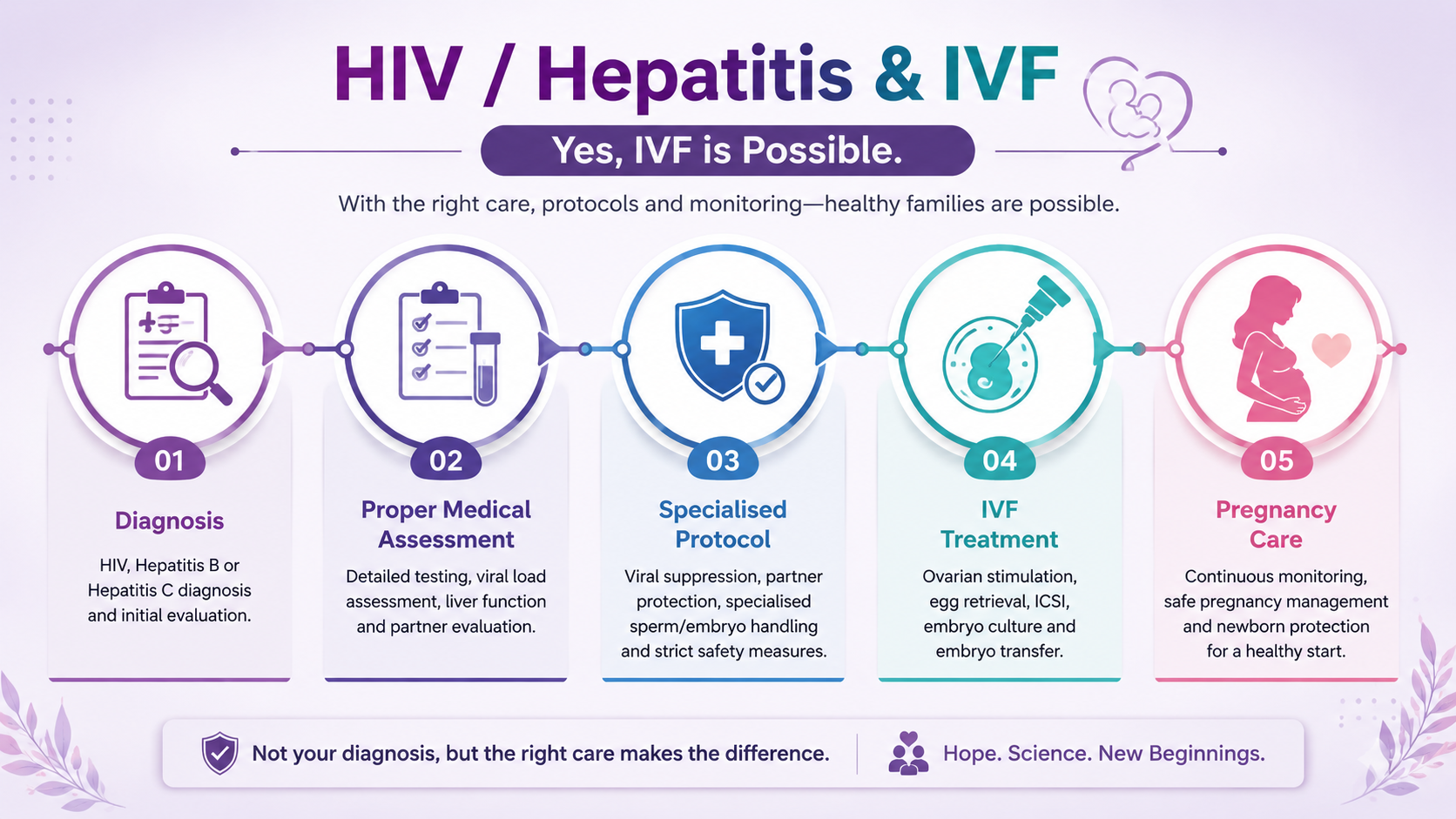
Every treatment plan at Delhi IVF is personalised, but the following framework applies across most positive cases.
When the Male Partner is Positive
The safest, most established approach is sperm washing followed by ICSI. Sperm washing uses density gradient centrifugation and swim-up techniques to separate motile sperm from the surrounding seminal fluid and non-sperm cells, which is where the virus resides. The processed sperm is then tested for viral RNA and, if clear, used to fertilise the egg through ICSI, which involves injecting a single sperm directly into the egg. Global cohort data has documented zero horizontal transmissions in thousands of cycles using this protocol for HIV positive men.
When the Female Partner is Positive
The focus shifts to viral suppression before stimulation, careful monitoring of liver and immune function during the cycle, and coordinated care with the treating physician or infectious disease specialist. Antiretroviral therapy is continued throughout treatment. Post-transfer, obstetric care includes viral load checks each trimester and a delivery plan designed to minimise perinatal transmission.
When Both Partners are Positive
Concordant positive couples still undergo IVF successfully. The protocol combines sperm processing (if male viral load is detectable), suppression optimisation for the female, and enhanced newborn prophylaxis planning. Discordance in disease type (for example, one partner HIV positive, the other Hepatitis B positive) is also managed routinely.
Additional Considerations by Condition
HIV positive patients: Confirm at least six months of undetectable viral load on ART. Sperm washing plus ICSI remains the gold standard for male-positive cases even under U=U, because the extra layer of safety costs little and reassures both partners.
Hepatitis B positive patients: The negative partner should be vaccinated (three-dose series) before starting the cycle. The newborn receives HBIg and the first HBV vaccine dose within 12 hours of birth, followed by the standard vaccination schedule. Post-vaccination serology is checked between 9 and 12 months.
Hepatitis C positive patients: Where possible, complete DAA therapy first and confirm sustained virological response before starting IVF. This removes the transmission question entirely. When treatment cannot wait, sperm processing and careful monitoring are used.
The Step-by-Step IVF Journey for Positive Patients at Delhi IVF
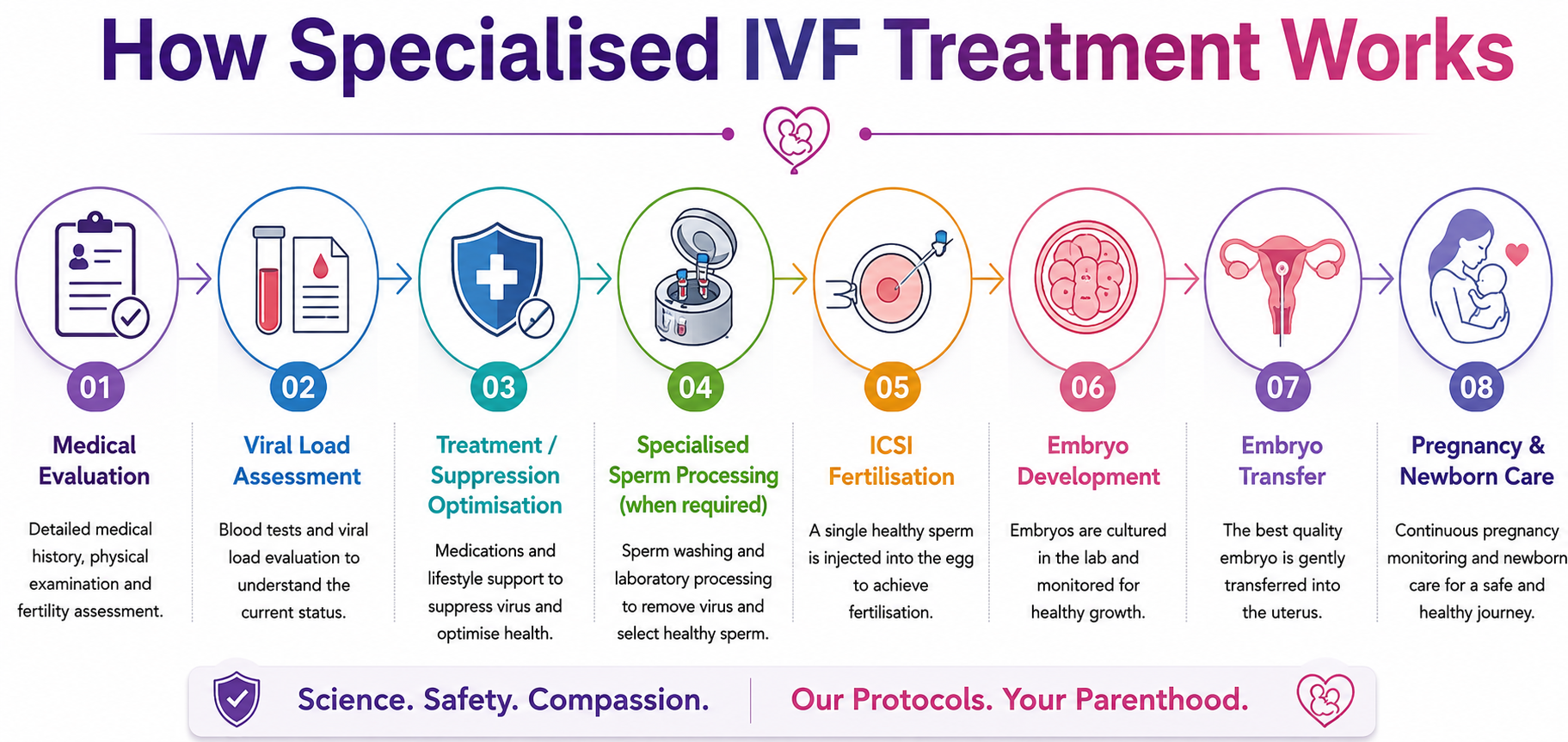
- Confidential consultation with our fertility team, including full history, diagnosis review and honest discussion of options
- Complete workup: viral load, CD4 count (for HIV), HBV DNA or HCV RNA, liver function tests, hormonal profile and semen analysis
- Partner assessment, including vaccination status where relevant
- Viral suppression optimisation in coordination with your treating physician
- Advanced sperm processing where indicated for male-positive cases
- Ovarian stimulation with tailored medication protocols
- Egg retrieval under mild sedation
- ICSI fertilisation in our advanced embryology laboratory
- Embryo culture and grading, with genetic screening available on request
- Embryo transfer and luteal support
- Pregnancy confirmation and specialised obstetric follow-up
- Delivery and newborn prophylaxis planning with your obstetrician and paediatrician
Cost of IVF for HIV and Hepatitis Positive Patients in India
Fertility treatment costs for positive patients include the standard IVF cycle plus additional testing and specialised processing. All figures below are indicative ranges in Indian Rupees.
| Component | Estimated cost (INR) |
| Initial consultation and viral workup | 5,000 to 12,000 |
| Complete IVF cycle with ICSI | 1,50,000 to 2,50,000 |
| Advanced sperm processing (per cycle) | 25,000 to 60,000 |
| DAA therapy for Hepatitis C (approximate) | 25,000 to 80,000 |
| Additional monitoring and viral load tests | 8,000 to 20,000 |
| Newborn HBIg and vaccination | 3,000 to 8,000 |
At Delhi IVF, all costs are discussed openly before treatment begins. There are no hidden charges, and financial counselling is available for couples who need to plan the journey in stages.
Success Rates for HIV and Hepatitis Positive Patients
Success rates for positive patients on suppressive therapy are broadly comparable to standard IVF outcomes when the disease is well controlled, and no other fertility factors are present. Delhi IVF's overall IVF success rate ranges between 50% and 80% depending on age, ovarian reserve, and specific medical history. Untreated or poorly controlled viral infection can affect both fertility and cycle outcomes, which is why the pre-cycle preparation phase is critical.
Your Rights as a Positive Patient in India
The Assisted Reproductive Technology (Regulation) Act 2021 explicitly prohibits discrimination in the provision of ART services based on sexual orientation, marital status or health status. NACO guidelines further support access to reproductive care for people living with HIV. If a clinic refuses you treatment solely based on your HIV or hepatitis status, you have grounds to request written justification, seek a second opinion at an accredited centre, and report the refusal to the relevant state health authority.
Delhi IVF's stance is straightforward. Your diagnosis is a medical fact we work with, not a reason to close the door.
Why Choose Delhi IVF for HIV and Hepatitis Positive Fertility Treatment
- 34+ years of fertility expertise under Dr. Anoop Gupta, who delivered Delhi's first ICSI baby in 1996
- 25,000+ successful deliveries across a wide range of complex cases
- Advanced embryology laboratory led by Mrs. Alka Gupta, Chief Embryologist with 32+ years of experience
- Integrated care coordinated by Dr. Aastha Gupta with your infectious disease physician or hepatologist
- Complete confidentiality and non-judgemental counselling at every stage
- Full range of assisted reproduction services including male infertility treatment, surgical sperm retrieval and egg and sperm freezing for fertility preservation
- International patient support with experience treating couples from 66+ countries
Take the Next Step Toward Parenthood
You do not have to accept "no" as the answer. If you or your partner is living with HIV, Hepatitis B or Hepatitis C and you want to build a family, Delhi IVF and Fertility Research Centre is ready to help. Our team offers confidential consultation, honest medical assessment, and a treatment plan built around your specific situation.

