

If a doctor has mentioned your AMH level, or you have just seen the words "low AMH" on a lab report, you are not alone in wanting clear answers. AMH testing has become one of the most commonly requested fertility diagnostics in India, and yet the results are often explained in ways that leave women more confused than reassured.
The AMH test measures your ovarian reserve, which is a way of estimating roughly how many eggs you have left. It does not measure egg quality, and it does not predict exactly when you will reach menopause. What it does provide is a useful starting point for fertility planning. In this guide, the specialists at Delhi IVF explain what the AMH test is, what your result means, what is considered normal at your age, and what your options look like if your AMH is lower than expected.
What is the AMH Test?
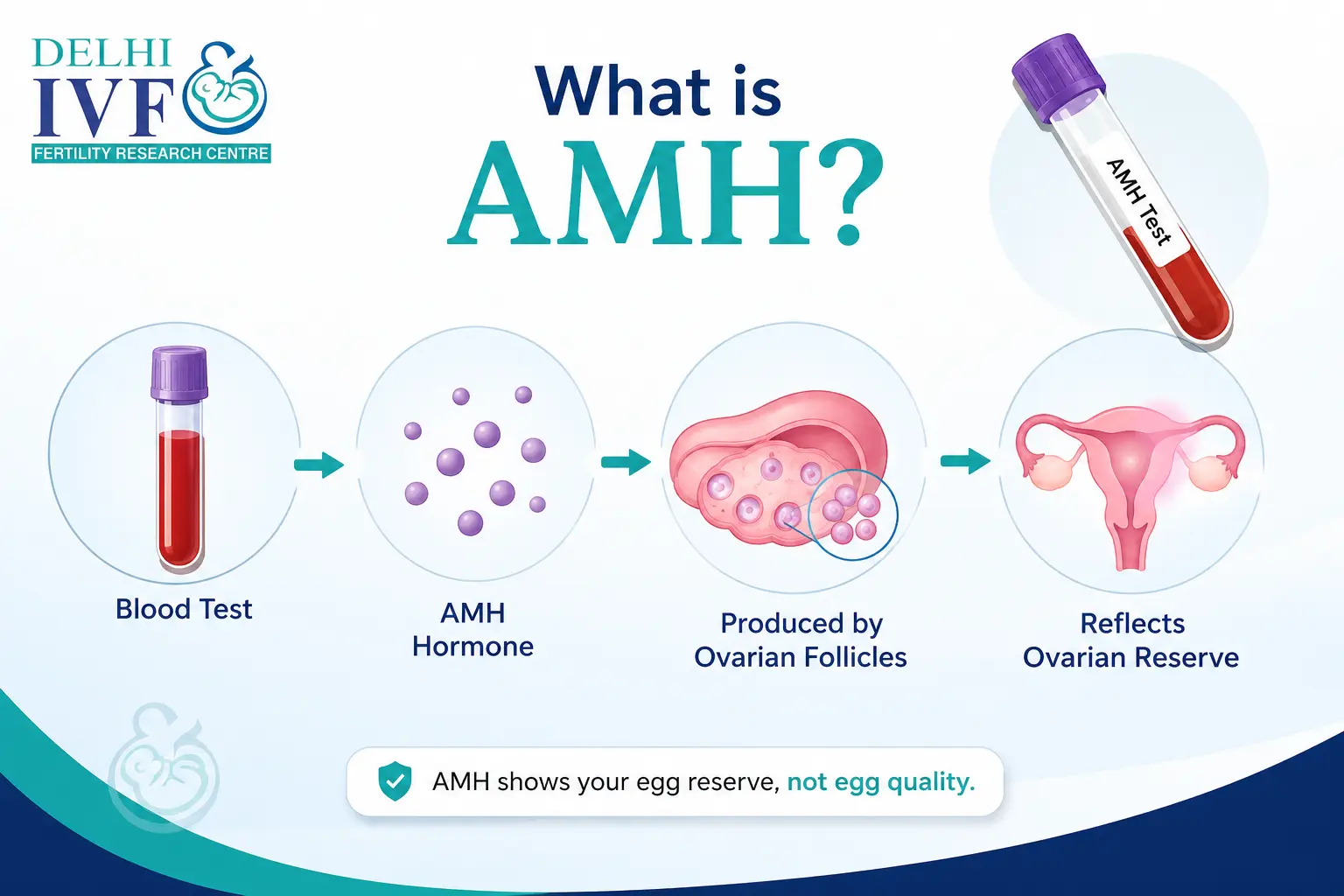
AMH stands for Anti-Mullerian Hormone. It is a hormone produced by the small follicles inside your ovaries, and the amount in your blood roughly reflects how many follicles you still have. In simple terms, more follicles mean more AMH, and fewer follicles mean less AMH.
Unlike other fertility hormones such as FSH or LH, AMH levels stay relatively stable throughout your menstrual cycle. This is why you can have the test done on any day of your cycle without needing to time it around your period. The test is a simple blood test, and the results are usually available within two to three days.
AMH testing does not tell you whether you are currently ovulating, and it does not measure egg quality. What it does do is give your doctor a useful snapshot of your ovarian reserve, which becomes important when planning for pregnancy, considering egg freezing, or starting fertility treatment.
Why is the AMH Test Done?
Doctors recommend AMH testing in several situations, most commonly linked to fertility planning. Common reasons include:
- Investigating unexplained infertility in couples trying to conceive
- Predicting how ovaries will respond to IVF stimulation medications
- Diagnosing conditions like PCOS, where AMH is often unusually high
- Assessing ovarian reserve before egg freezing
- Monitoring ovarian function during or after cancer treatment
- Estimating how close a woman may be to menopause
- Planning fertility preservation for women delaying pregnancy
For women over 30 who are considering starting a family in the coming years, AMH testing is one of the most useful pieces of information a fertility specialist can access. It shapes decisions about how long to try naturally, when to seek help, and which treatment approach is most likely to succeed.
AMH Normal Range by Age
AMH levels naturally decline with age, so what counts as "normal" depends heavily on how old you are. The table below shows the general reference ranges used by most fertility labs in India.
| Age Group | Normal AMH Range (ng/mL) | What It Suggests |
| Under 25 years | 3.0 to 6.8 | High to very high reserve |
| 25 to 30 years | 2.5 to 4.0 | Good reserve |
| 31 to 35 years | 1.5 to 2.5 | Average reserve |
| 36 to 40 years | 1.0 to 1.5 | Low to average reserve |
| 41 to 45 years | 0.5 to 1.0 | Low reserve |
| Over 45 years | Less than 0.5 | Very low reserve |
These ranges are guidelines rather than absolutes. A 32-year-old woman with an AMH of 1.2 may still conceive naturally, while a 28-year-old with the same reading may find it more difficult. Age, family history, lifestyle, and existing medical conditions all influence what a specific number means for you personally. This is why AMH results are always interpreted alongside other tests, including antral follicle count and FSH, rather than in isolation.
What Does Low AMH Mean?
A low AMH result means your ovarian reserve is smaller than expected for your age. It does not mean you cannot get pregnant, but it does suggest that natural conception may take longer or become harder as time passes.
Common causes of low AMH include:
- Advancing age, which is the single strongest factor
- Genetic conditions such as fragile X syndrome or Turner syndrome
- Previous ovarian surgery
- Chemotherapy or radiation treatment
- Autoimmune conditions
- Smoking and long-term stress
Women with low AMH still ovulate and can still conceive, whether naturally or with fertility treatment. What low AMH does affect is time. It suggests that the window for conception may be shorter than average, which is why fertility specialists often recommend acting sooner rather than waiting.
If you receive a low AMH result, the most important next step is a full fertility assessment rather than panic. Options like egg freezing or beginning IVF treatment earlier than planned can meaningfully change outcomes for women with low AMH.
What Does High AMH Mean?
High AMH is less commonly discussed but can also carry information about your reproductive health. AMH readings above 4.0 ng/mL, particularly in younger women, are often associated with polycystic ovary syndrome or PCOS.
Women with PCOS produce more follicles than average, which raises AMH levels. High AMH in this context is not necessarily bad news for fertility, but it does mean your fertility specialist will approach IVF stimulation differently, using lower doses to avoid the risk of ovarian hyperstimulation syndrome.
High AMH without PCOS is uncommon but not concerning on its own. Your doctor will interpret the result alongside your overall clinical picture.
AMH Test Procedure and Preparation
The AMH test is one of the simplest fertility tests to undergo. It requires only a blood sample, which is drawn from a vein in your arm, just like any routine blood test. Because AMH levels remain stable across the menstrual cycle, there is no need to wait for a specific day of your period.
You do not need to fast before an AMH test, and no special preparation is needed. Results are usually available within 24 to 72 hours, depending on the lab. Most fertility clinics can arrange the test as part of an initial consultation. Once your result is available, your fertility specialist will discuss what the number means for your specific situation, along with any next steps.
AMH Test Cost in India
The cost of an AMH test in India varies by city, lab, and whether it is done as part of a wider fertility panel. On its own, the test typically costs between INR 1,500 and INR 3,500 in most metros, including Delhi.
When the AMH test is done as part of a fertility assessment package alongside FSH, LH, thyroid, and ultrasound, the combined cost is usually more economical. Delhi IVF offers structured fertility assessment packages that include AMH testing at competitive prices. To learn about current pricing at our centre, we recommend booking a consultation so your options can be tailored to your specific situation.
Can You Get Pregnant with Low AMH?
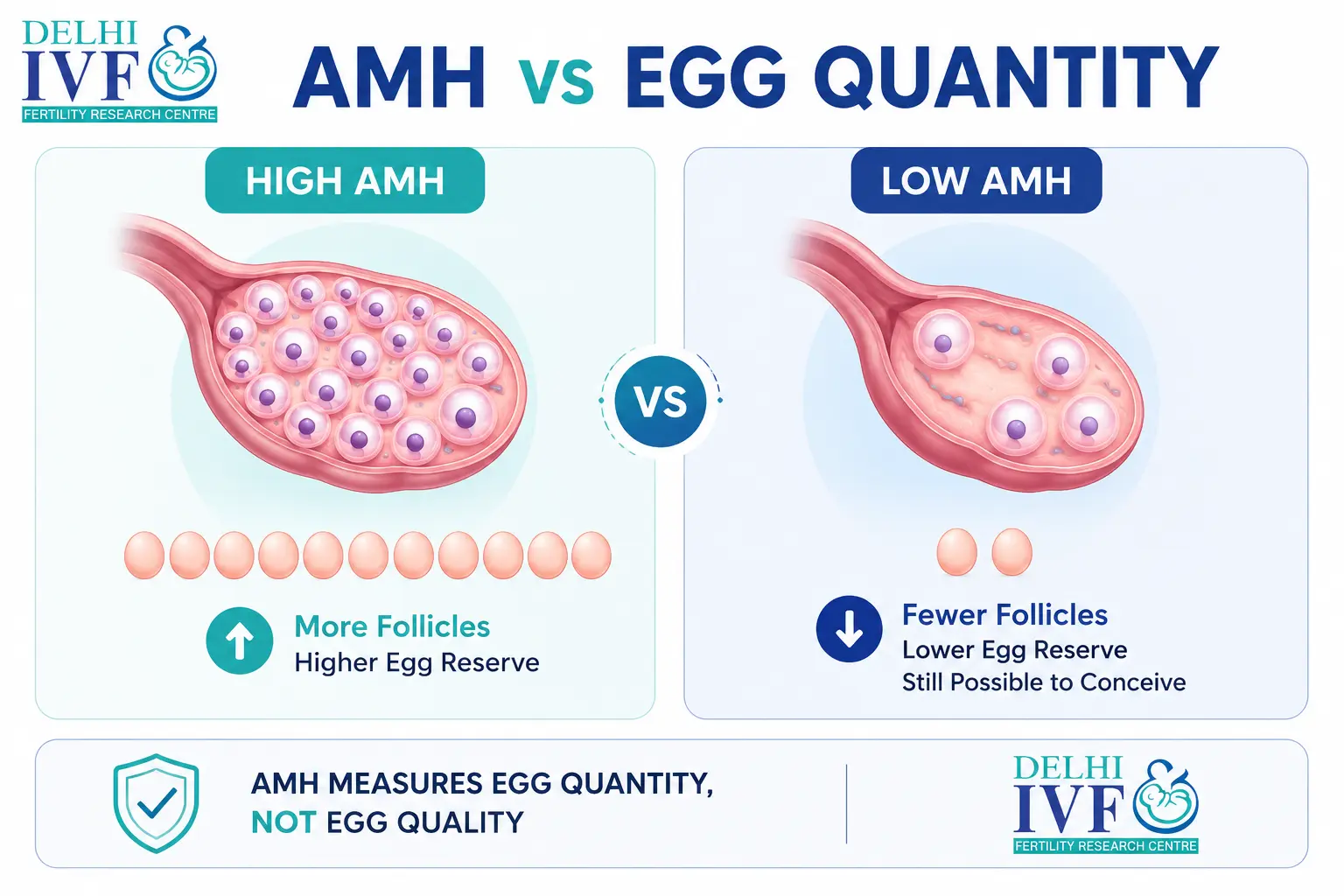
Yes. Low AMH does not automatically mean infertility. Many women with low AMH conceive naturally, and many more conceive with fertility treatment. What low AMH tells your doctor is that you may need to move faster than average, not that pregnancy is off the table.
Here is why this matters. AMH reflects egg quantity, not egg quality. A woman in her early 30s with low AMH still typically has good egg quality, which is the most important factor in whether an embryo results in a healthy pregnancy. This is why women with low AMH often respond well to IVF, particularly when treatment begins early.
If your AMH is low and you are trying to conceive:
- Get a full fertility assessment rather than relying on AMH alone
- Consider your best age to conceive alongside your AMH result
- Discuss egg freezing if you are not ready to conceive immediately
- Explore IVF earlier rather than trying naturally for years
- Address lifestyle factors that affect fertility, including smoking, stress, and weight
Low AMH is a signal to act, not a diagnosis of infertility.
How Does AMH Affect IVF Success?
AMH is one of the strongest predictors of how ovaries will respond to IVF medication. Higher AMH usually means more eggs will be retrieved in a single cycle, while lower AMH means fewer eggs per cycle.
However, IVF success ultimately depends on egg quality and embryo development, not just the number of eggs retrieved. A woman with low AMH but good egg quality may need more IVF cycles to accumulate enough good embryos, but her chance of eventual pregnancy remains strong. Advanced techniques like ICSI further improve embryo development in challenging cases.
At Delhi IVF, personalised protocols are designed around each woman's AMH level, age, and overall clinical profile. This tailored approach is one of the reasons our centre has supported over 25,000 successful deliveries.
How to Improve AMH Naturally
AMH declines with age, and no supplement or lifestyle change can fully reverse the natural loss of follicles. That said, certain factors can support ovarian health and slow further decline:
- Stop smoking, which accelerates ovarian aging
- Maintain a healthy weight
- Take vitamin D if you are deficient
- Include CoQ10 and omega-3 fatty acids, under medical guidance
- Manage stress through sleep, exercise, and mindfulness
- Address underlying conditions like thyroid disorders
Be cautious of products claiming to boost AMH dramatically. Sustainable improvements come from overall reproductive health rather than any single pill.
Fertility Assessment at Delhi IVF
At Delhi IVF & Fertility Research Centre, AMH testing is part of a comprehensive fertility evaluation offered to women at every stage of their family planning journey. Since 1993, our centre has helped couples from India and 66 countries worldwide, delivering over 25,000 babies through advanced fertility care.
Under the leadership of Dr. Anoop Gupta, our team believes AMH results should never be a source of panic. They are one important piece of the wider picture, and with the right guidance, most women with concerning AMH results still go on to build the families they hoped for.
If you would like a professional evaluation of your fertility, we are here to help.

