
You have just been diagnosed. Or you have known for years, and now you are ready to start a family. Either way, the same question keeps circling in your mind: can our baby really be born healthy and free of the virus?
The honest, evidence-backed answer is yes. Modern reproductive medicine has produced tens of thousands of healthy, virus-free babies to parents living with HIV, Hepatitis B, and Hepatitis C. Global cohort data spanning over 11,000 IVF cycles have documented zero HIV transmissions to babies born through sperm washing plus ICSI. Systematic reviews confirm that IVF outcomes for hepatitis positive couples are broadly comparable to those without infection. And direct-acting antivirals now cure Hepatitis C in 8 to 12 weeks, removing the transmission question entirely.
At Delhi IVF and Fertility Research Centre, under the direction of Dr. Anoop Gupta, HIV and hepatitis positive parents have been welcomed and treated as part of routine IVF practice for many years. This blog explains exactly what the success rates look like, what the safety data shows, and how modern protocols make a healthy baby the expected outcome rather than the exception.
Can HIV Positive Parents Really Have Healthy, HIV-Negative Babies Through IVF?
Yes. The evidence here is one of the most powerful stories in modern reproductive medicine.
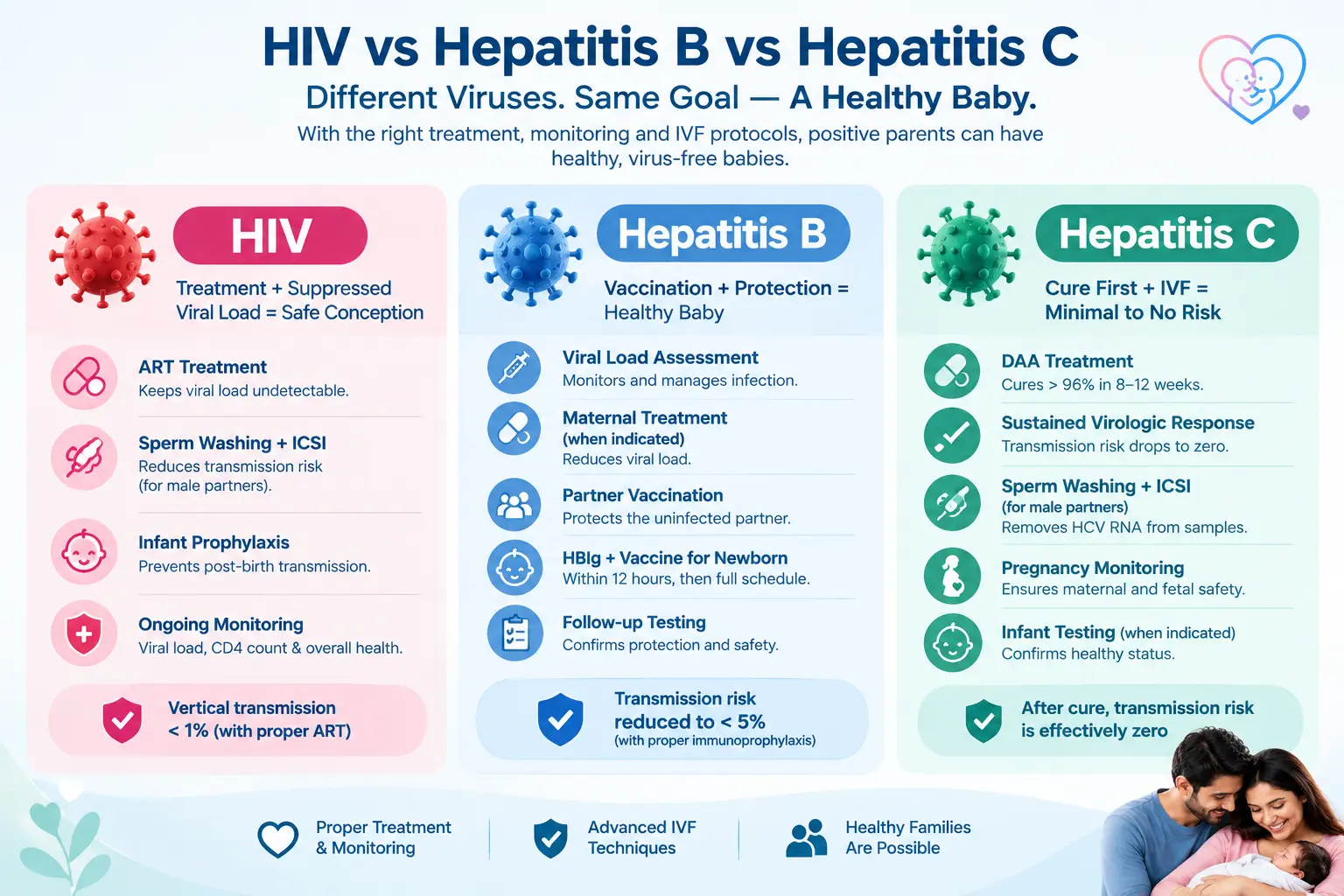
- Vertical transmission (mother to baby) has fallen from around 30% in the pre-treatment era to under 1% today when the mother is on sustained antiretroviral therapy (ART), with appropriate delivery planning and newborn prophylaxis.
- Horizontal transmission (positive partner to negative partner) has been documented at effectively zero in global cohort data of over 11,000 cycles using sperm washing plus ICSI for HIV positive fathers.
- U=U (Undetectable equals Untransmittable), a scientific consensus endorsed by over 1,000 health organisations, confirms that a person with sustained undetectable HIV viral load on ART poses no meaningful sexual transmission risk to their partner.
Real-world cases published in Indian medical journals confirm that HIV serodiscordant couples in India regularly achieve successful pregnancy and healthy babies through IVF/ICSI with sperm washing, even when combined with additional fertility factors like oligospermia or PCOS.
Can Hepatitis B Positive Parents Have a Healthy Hepatitis B-Negative Baby?
Yes, and the data behind this answer is now decades deep.
- A 2024 systematic review and meta-analysis confirmed that HBV positive women undergoing IVF have live birth rates that are not significantly different from HBV negative controls. Neonatal outcomes were also comparable.
- Even when HBV DNA has been detected in oocytes and embryos, follow-up studies have shown that this does not translate into vertical transmission when standard immunoprophylaxis is followed.
- With HBIg (Hepatitis B Immunoglobulin) plus birth-dose HBV vaccine within 12 hours of delivery, followed by the complete infant vaccination schedule, mother-to-child transmission is reduced to under 5%.
- When maternal HBV DNA is above 200,000 IU/ml, adding tenofovir antiviral therapy in the third trimester reduces the residual risk further.
Male HBV positive couples have similarly reassuring data. Meta-analyses show broadly preserved sperm parameters and pregnancy outcomes when standard IVF or ICSI is used alongside partner vaccination and newborn immunoprophylaxis.
Can Hepatitis C Positive Parents Have a Healthy Hepatitis C-Negative Baby?
Yes, and the paradigm has shifted dramatically in the past decade thanks to direct-acting antivirals.
- Vertical transmission of HCV without treatment is around 4 to 6%. There is no vaccine for Hepatitis C, so the strongest protection historically was careful obstetric monitoring.
- DAA therapy (sofosbuvir plus velpatasvir, sofosbuvir plus daclatasvir, or glecaprevir plus pibrentasvir) now cures over 96% of Hepatitis C patients in 8 to 12 weeks. Once sustained virologic response (SVR) is confirmed, transmission risk drops effectively to zero.
- A Chinese cohort of 1,424 couples found that HCV positive men and women had IVF outcomes broadly similar to HCV negative controls when standard protocols were followed.
- For HCV positive fathers, sperm washing plus ICSI removes HCV RNA from processed samples, and reproductive outcomes match those of HCV negative men.
The current best practice is "cure first, then IVF" wherever medically feasible, which delivers the safest and simplest pathway.
What Are the Actual Success Rates of IVF for HIV and Hepatitis Positive Patients?
When viral load is suppressed, and no other fertility factors are present, IVF success rates for HIV and hepatitis positive patients broadly match those of non-infected patients of the same age.
| Patient group | Live birth rate per cycle | Notes |
| HIV positive with undetectable viral load | Comparable to age-matched HIV negative controls | Requires sustained ART for at least 6 months |
| Hepatitis B positive (either partner) | No significant difference from HBV negative controls (2024 meta-analysis) | Partner vaccination and newborn HBIg required |
| Hepatitis C positive, DAA-cured | Comparable to HCV negative controls | SVR12 confirmed before starting IVF cycle |
| Hepatitis C positive, untreated | Broadly similar in most studies; slight reduction in some | Cure with DAA first is the recommended pathway |
| Delhi IVF overall IVF success rate | 50% to 80% depending on age and factors | Same benchmarks apply to well-managed positive patients |
The most important variables that drive success are age, ovarian reserve, sperm quality, and the clinic's expertise in handling infectious disease coordination. Viral status itself, when properly managed, is not a limiting factor.
What Does the Global Safety Data Show?
The safety evidence for IVF in HIV and hepatitis positive patients is one of the most extensively studied areas in modern reproductive medicine. Key findings include:
- Zero horizontal HIV transmissions to female partners across published sperm washing cohorts of over 11,000 cycles
- Zero documented vertical HIV transmissions to babies born through this protocol
- Mother-to-child HBV transmission under 5% with HBIg plus birth-dose vaccination
- No significant impact on live birth rates for HBV positive women in the 2024 systematic review
- No increased risk of birth defects in babies born through sperm washing plus ICSI compared to standard IVF babies
- DAA-cured Hepatitis C patients show equivalent IVF outcomes to HCV negative patients, with no vertical transmission
- Standard universal precautions in accredited fertility laboratories protect other patients from any cross-contamination risk
This is not speculative. It is evidence generated over three decades of clinical practice across dozens of countries, thousands of clinics, and hundreds of thousands of cycles.
What Factors Affect Success and Safety in IVF for HIV or Hepatitis Positive Patients?
Some variables matter more than the diagnosis itself.
- Sustained viral suppression for at least six months before starting the IVF cycle
- Adequate CD4 count (for HIV) and stable liver function tests (for hepatitis)
- Female age and ovarian reserve (AMH, AFC) as with any IVF patient
- Male sperm parameters and whether male infertility treatment is also required
- Clinic expertise in sperm washing, viral RNA testing and integrated infectious disease coordination
- Partner protection status, including vaccination for HBV discordant couples and PrEP for HIV discordant couples where indicated
- Adherence to complete newborn prophylaxis including HBIg, antiretroviral prophylaxis or vaccination as clinically applicable
Well-managed patients often have outcomes that are indistinguishable from HIV or hepatitis negative patients of the same age and fertility profile.
What Do Doctors Do to Ensure the Baby is Born Healthy and Virus-Free?
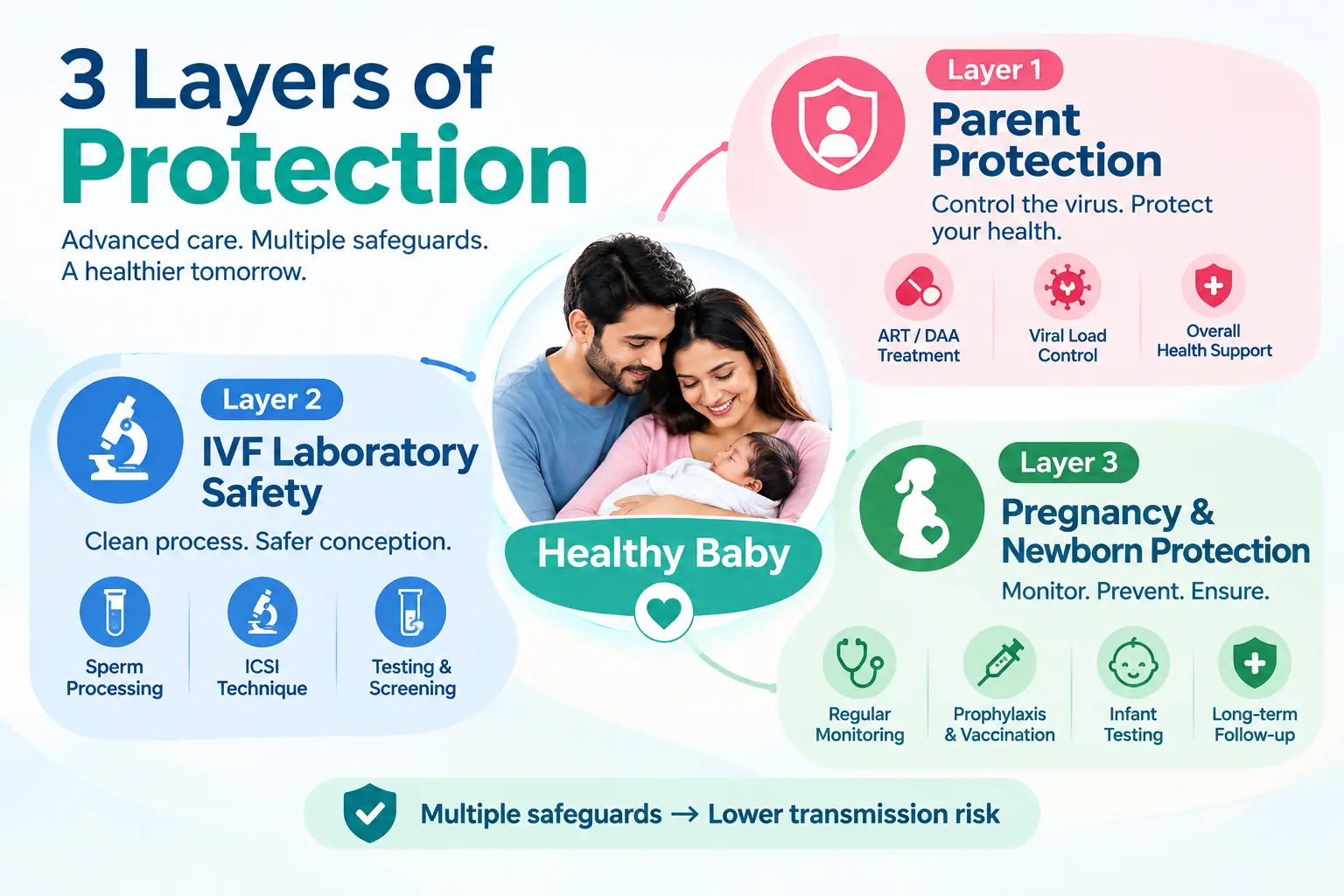
Modern IVF for HIV and hepatitis positive parents uses a layered protection approach.
| Condition | Layer 1 | Layer 2 | Layer 3 |
| HIV positive father | Sperm washing plus ICSI | HIV RNA testing of processed sample | PrEP for negative partner where indicated |
| HIV positive mother | ART throughout pregnancy | Elective caesarean if viral load not suppressed | Infant antiretroviral prophylaxis 4 to 6 weeks + formula feeding |
| HBV positive father | Standard sperm processing plus ICSI | Partner vaccination and antibody confirmation | Newborn HBIg plus birth-dose vaccine within 12 hours |
| HBV positive mother | Tenofovir in third trimester if high viral load | Newborn HBIg plus birth-dose vaccine within 12 hours | Complete infant vaccine schedule + serology at 9 to 12 months |
| HCV positive father | DAA cure preferred, or sperm washing plus ICSI | HCV RNA testing of processed sample if untreated | Standard newborn HCV testing at 18 months |
| HCV positive mother | DAA cure preferred before conception | Viral load monitoring during pregnancy if not cured | Newborn HCV RNA testing at 2 to 6 months |
Each layer independently reduces transmission risk. Together, they make a healthy, virus-free baby the expected outcome. Optional genetic screening can be added for couples who want additional embryo assessment.
Why Choose Delhi IVF for Safe IVF for HIV and Hepatitis Positive Parents?
- 34+ years of fertility expertise under Dr. Anoop Gupta, with Delhi's first ICSI baby delivered in 1996
- 25,000+ successful deliveries across a wide range of complex cases, including HIV and hepatitis positive parents
- Coordinated multidisciplinary care by Dr.Aastha Gupta, integrating your fertility treatment with your HIV physician, hepatologist, or infectious disease specialist
- Advanced andrology laboratory performing sperm processing and viral testing to WHO 2021 standards
- Complete confidentiality across all patient records, consultations and cycle documentation
- International patient experience with couples from 66+ countries, including many with complex viral infection histories
- Compassionate, non-judgemental counselling for both partners at every stage of the journey
Book Your Confidential Consultation
If you are HIV, Hepatitis B or Hepatitis C positive and you dream of holding a healthy baby of your own, that dream is medically achievable. Delhi IVF and Fertility Research Centre has walked this journey with thousands of couples across India and 66+ countries, and the outcomes are as hopeful as the science suggests.

